How to Combine Ratios
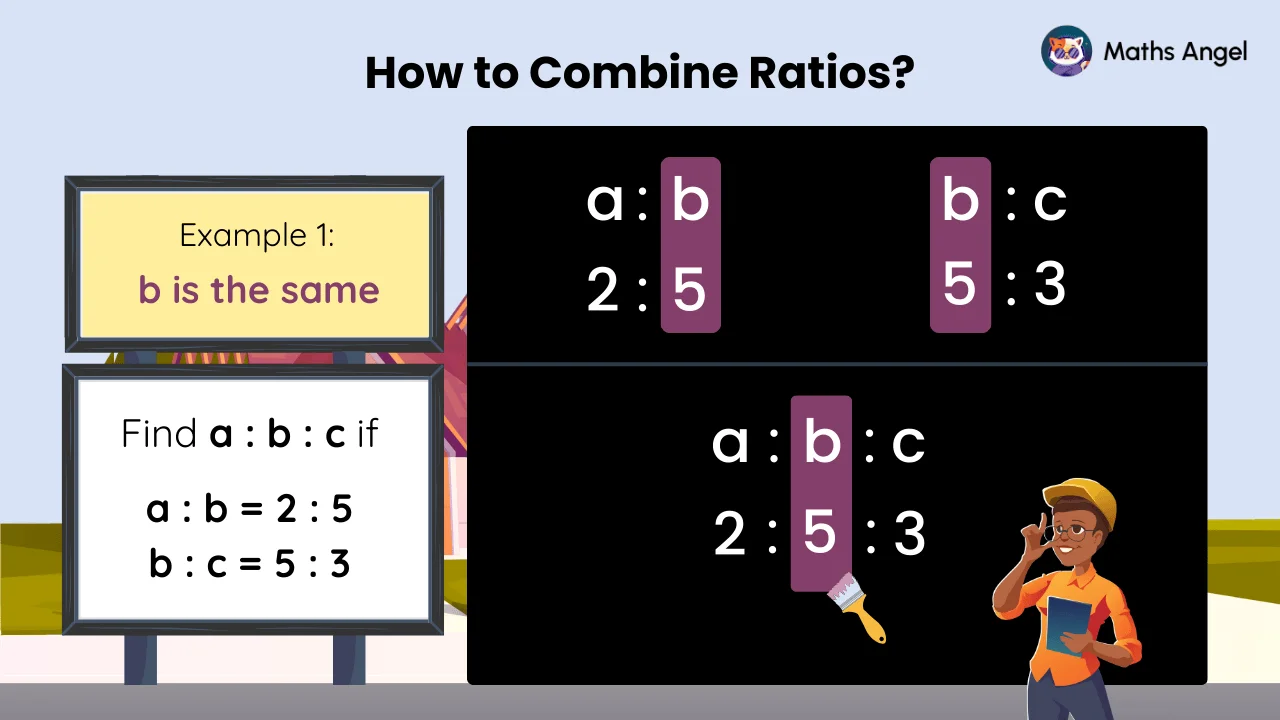
Combining ratios joins two ratios into one three-part ratio by matching the number they share. If a:b = 2:3 and b:c = 3:5, the shared 3 gives a:b:c = 2:3:5. If the shared numbers differ, scale them to their LCM first.

Video Lesson
Watch and learn the basics
🎬 Did this video explain it clearly?
Flashcards
Review key concepts visually
%20How%20to%20Combine%20Ratios%20With%20Same%20Common%20Factor.webp)
%20How%20to%20Combine%20Ratios%20Using%20LCM%20of%20Common%20Factor.webp)
%20Combining%20Ratios%20Applications%20Question%201.webp)
%20Combining%20Ratios%20Applications%20Question%202.webp)
Same Middle Number
- If the middle number is already the same, combine the ratios directly.
- Example: if and , then .
Different Middle Numbers
- If the middle numbers are different, make them the same first using the LCM.
- Example: and → make both have .
Writing the Combined Ratio
- Once the middle numbers match, write all three parts together as one ratio.
- Example: and combine to give .
What the Combined Ratio Means
- A combined ratio shows how three quantities compare at the same time.
- Example: means for every 24 of the first amount, there are 18 of the second and 45 of the third.
Practice Questions
Test your understanding
If and , what is ?
Correct! 🎉 +10 pointsCorrect! 🎉 Worth 10 XPNot quite right
To combine two ratios, the shared letter must have the same part in both.
Here is already 3 in and in , so no scaling is needed.
Keep each letter in its own place: , , .
So .
If and , what is ?
Correct! 🎉 +10 pointsCorrect! 🎉 Worth 10 XPNot quite right
To combine two ratios, the shared letter must have the same part in both.
Here is already 7 in and in , so no scaling is needed.
Keep each letter in its own place: , , .
So .
No number divides into all three parts, so is already in its simplest form.
If and , what is ?
Correct! 🎉 +20 pointsCorrect! 🎉 Worth 20 XPNot quite right
The letter appears in both ratios, so scale each ratio until the two parts match. The LCM of 5 and 2 is 10.
Scale by 2 to get . Scale by 5 to get .
Now is 10 in both, so they can be joined: . Remember that both parts of a ratio must be multiplied by the same number. You cannot simply write the two ratios side by side.
In a bag, the ratio of blue balls to green balls is . The ratio of red balls to green balls is . What is the combined ratio of red:green:blue?
Correct! 🎉 +20 pointsCorrect! 🎉 Worth 20 XPNot quite right
Green appears in both ratios, so make the green parts match. Green is 2 in red:green and 4 in blue:green , and the LCM of 2 and 4 is 4.
Scale red:green by 2 to get . Blue:green already has green as 4, so it stays as it is.
The question asks for red:green:blue, so keep that order: .
If and , what is ?
Correct! 🎉 +20 pointsCorrect! 🎉 Worth 20 XPNot quite right
appears in both ratios, so make the two parts match. The LCM of 6 and 4 is 12.
Scale by 2 to get . Scale by 3 to get .
Both parts of a ratio must be multiplied by the same number, so joining them gives .
In a fruit blend, the ratio of apples to bananas is . The ratio of bananas to grapes is . If you used 25 apples, how many grapes are in the mix?
Correct! 🎉 +30 pointsCorrect! 🎉 Worth 30 XPNot quite right
Bananas are 3 parts in both ratios, so the two ratios link straight away: apples:bananas:grapes .
The 5 parts of apples stand for 25 apples, so one part is .
Grapes are 2 parts, so there are grapes. (Bananas would be , but the question asks about grapes.)
Want to see the full working?
Interactive Activity
Combine two ratios into one using LCM
Loading interactive widget...
Frequently asked questions
The questions students bump into most on this topic
A combined ratio joins two ratios that share a quantity into one three-part ratio. If a:b = 2:5 and b:c = 5:3, the shared b is 5 in both, so a:b:c = 2:5:3. It means for every 2 parts of a there are 5 parts of b and 3 parts of c. All three quantities can then be compared at once.
Find the shared quantity and make it the same number in both ratios, then join the three parts. If a:b = 3:5 and b:c = 2:7, b is 5 in one and 2 in the other; the lowest common multiple of 5 and 2 is 10, so scale to 6:10 and 10:35, giving a:b:c = 6:10:35. Scaling does not change what a ratio means.
A typical question gives two ratios with a shared part and asks for the three-part ratio, often in a real setting. For example: water to cement is 4:3 and cement to sand is 2:5; find water:cement:sand. Cement is 3 in one ratio and 2 in the other, their lowest common multiple is 6, so scale to 8:6 and 6:15, giving 8:6:15.
Find the value of one part by dividing a known amount by its number of parts, then multiply by the parts you need. In the ratio water:cement:sand = 8:6:15, if there are 24 buckets of water, one part is 24 ÷ 8 = 3 buckets. Sand is 15 parts, so you need 15 × 3 = 45 buckets of sand.
What's next?
Found this one hard? Go one step back first. Feeling confident? Carry on to the next lesson.