Fractions and Percentages
Fractions and percentages are two ways to write the same amount. To turn a fraction into a percentage, make the denominator 100. A percentage always means out of 100.
Video Lesson
Watch and learn the basics
🎬 Did this video explain it clearly?
Flashcards
Review key concepts visually
%20Percentages.webp)
%20Converting%20Fractions%20to%20Percentages.webp)
%20Percentages%20Example.webp)
What Is a Percentage?
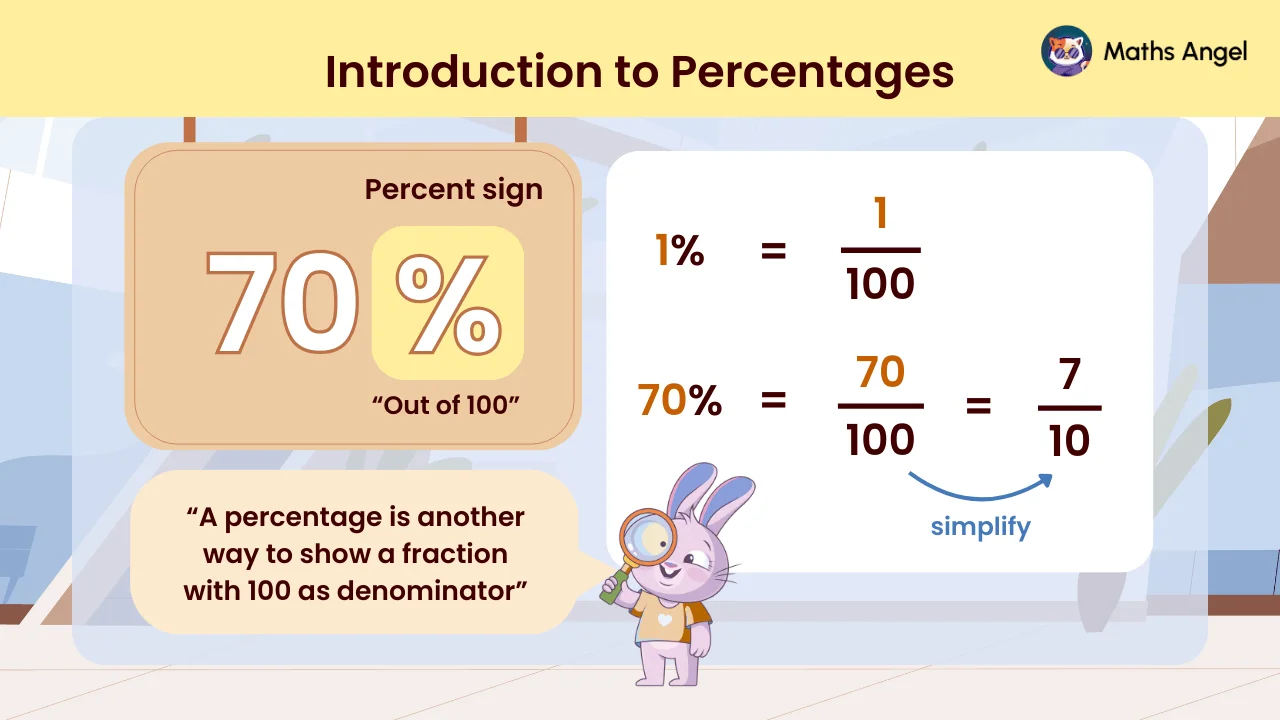
- A percentage means “out of 100” (e.g. .
- It is another way of writing a fraction with denominator 100.
Converting Fractions to Percentages
- Change the fraction so the denominator is 100. For example, .
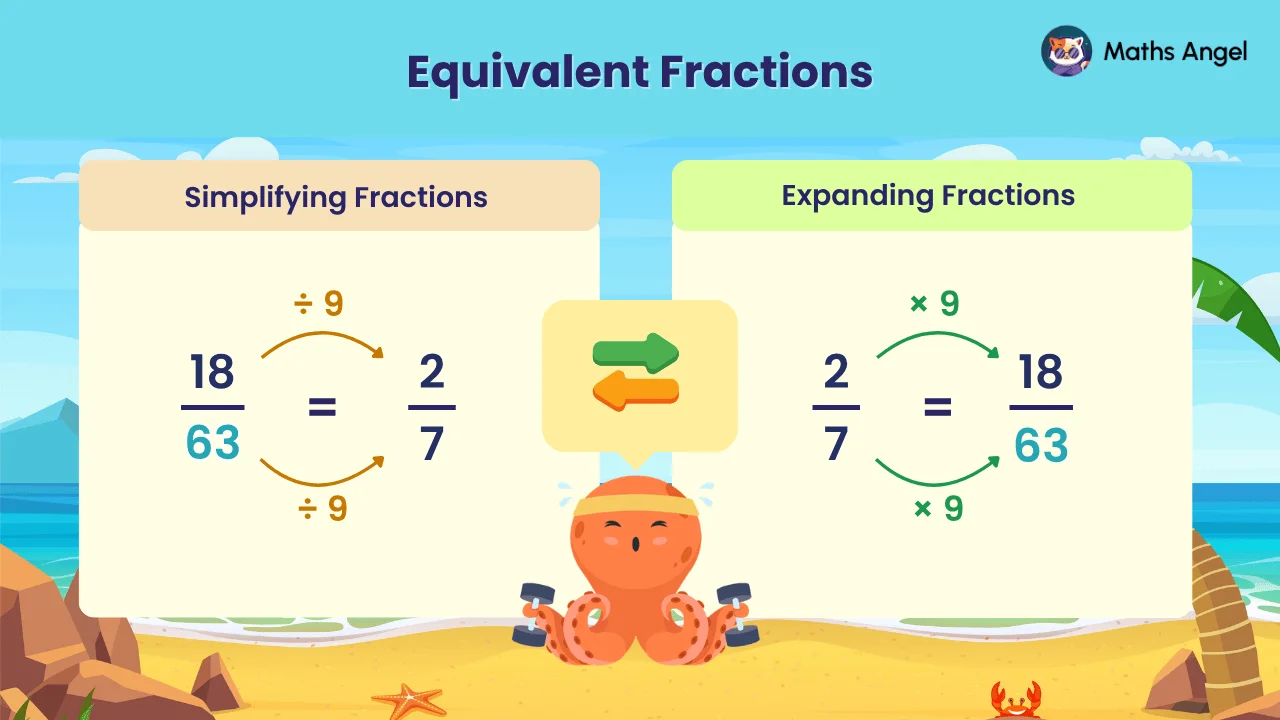
- You can do this by expanding or simplifying the fraction.
Finding a Percentage of a Total
- To find a percentage, divide the part by the total and multiply by 100 (e.g. .
- All parts together should add up to (e.g. .
Practice Questions
Test your understanding
Which of these percentages is equal to ?
Correct! 🎉 +10 pointsCorrect! 🎉 Worth 10 XPNot quite right
means . To turn a fraction or decimal into a percentage, multiply by 100: . So .
What is as a fraction in its simplest form?
Correct! 🎉 +10 pointsCorrect! 🎉 Worth 10 XPNot quite right
'Per cent' means 'out of 100', so is . Divide the numerator and denominator by their highest common factor, 20: .
A school has 30 teachers, and 12 of them teach science. What percentage of the teachers teach science?
Correct! 🎉 +20 pointsCorrect! 🎉 Worth 20 XPNot quite right
Write the science teachers as a fraction of all the teachers, then multiply by 100.
, and .
So of the teachers teach science.
Check: of 30 is 3, so of 30 is . ✓
A sports team played 45 games and won 27 of them. What percentage of the games did they win?
Correct! 🎉 +20 pointsCorrect! 🎉 Worth 20 XPNot quite right
Write the games won as a fraction of all the games played, then multiply by 100.
, and .
So the team won of their games.
Check: of 45 is 4.5, so of 45 is . ✓
A company sells 120 items in a month, and 96 of them are on sale. What percentage of items sold were on sale?
Correct! 🎉 +20 pointsCorrect! 🎉 Worth 20 XPNot quite right
Write the sale items as a fraction of all the items sold, then multiply by 100.
, and .
So of the items sold were on sale.
Check: of 120 is 12, so of 120 is . ✓
What fraction represents in its simplest form?
Correct! 🎉 +30 pointsCorrect! 🎉 Worth 30 XPNot quite right
A percentage means 'out of 100', so .
The highest common factor of 120 and 100 is 20, so divide top and bottom by 20:
.
Because is more than , the answer is correctly bigger than 1: .
Want to see the full working?
Interactive Activity
Practise converting fractions to percentages by finding equivalent fractions
Loading interactive widget...
Frequently asked questions
The questions students bump into most on this topic
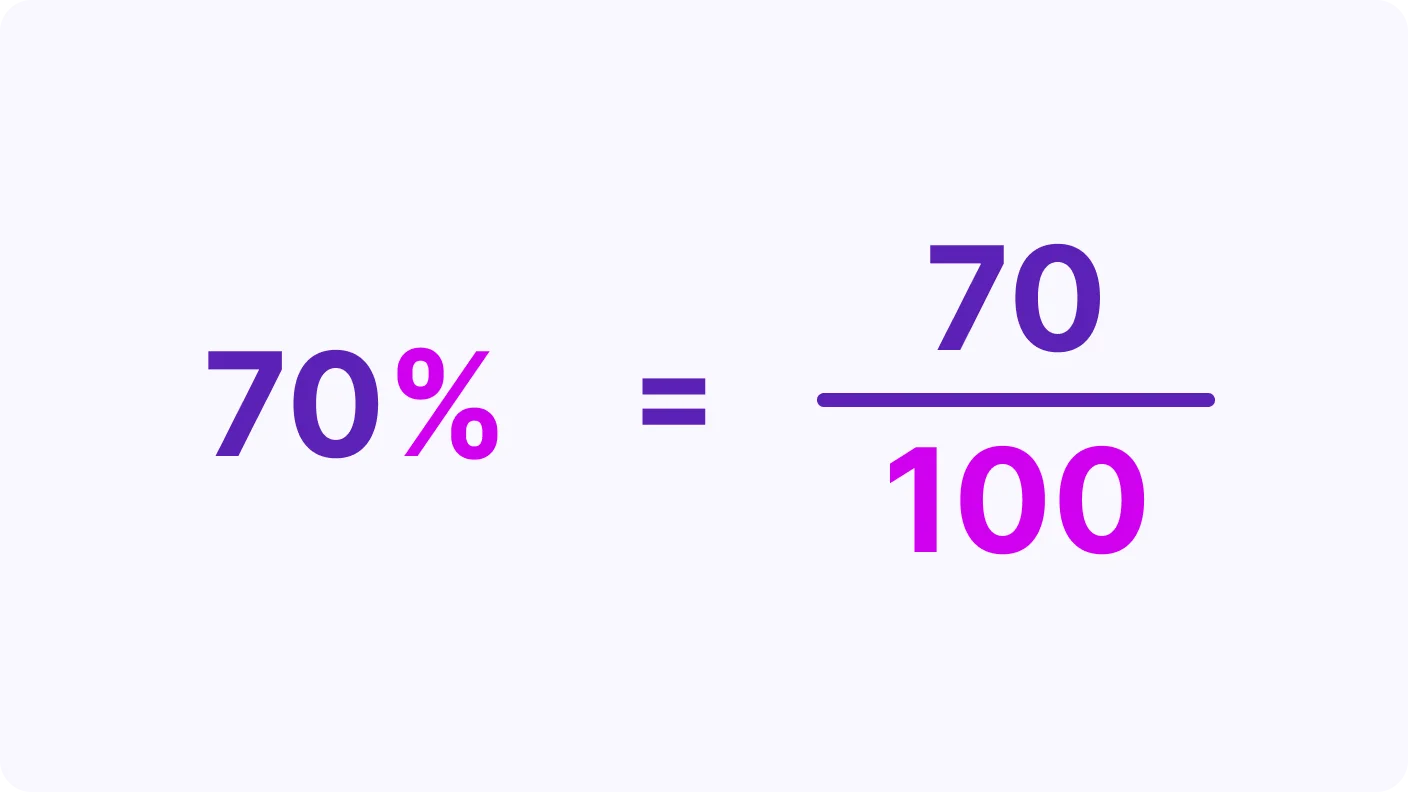
Per cent means out of one hundred, so a percentage is a fraction with 100 as its denominator: 70% is 70 out of 100, which simplifies to 7/10, and 1% is one hundredth. That is the only difference between the two: every percentage can be written as a fraction and every fraction as a percentage.
Change the fraction so its denominator is 100; the numerator is then the percentage. If the denominator divides into 100, multiply: 6/25 becomes 24/100 by multiplying top and bottom by 4, so 6/25 = 24%. If the denominator is bigger than 100, divide instead: 15/300 becomes 5/100 by dividing both by 3, so it is 5%.
Write the percentage over 100, then simplify. 70% is 70/100, and dividing top and bottom by 10 gives 7/10. 20% is 20/100, which simplifies to 1/5. If the percentage is over 100, the fraction is bigger than one whole: 120% is 120/100, or 6/5.
Write the first number as a fraction of the total, then change the denominator to 100. A club has 8 footballs and 12 basketballs, 20 balls in all. The footballs are 8/20; multiply top and bottom by 5 to get 40/100, so 40%. The basketballs are 12/20 = 60/100 = 60%, and the two parts add up to 100%.
3/5 is 60%. Multiply the top and bottom by 20 so the denominator becomes 100: 3/5 = 60/100, and 60 out of 100 is 60%. In the same way, 2/5 = 40/100 = 40%, and 1/5 = 20%. Any fraction whose denominator divides into 100 can be converted this way.
Say that per cent means out of 100, then use a 100-square grid: colour 70 squares and that is 70%, which is the same as 7 out of every 10. Shop sales are the best practice: a sign saying 50% off means half, and 25% off means a quarter.
What's next?
Found this one hard? Go one step back first. Feeling confident? Carry on to the next lesson.