How to Find Percentage of a Number
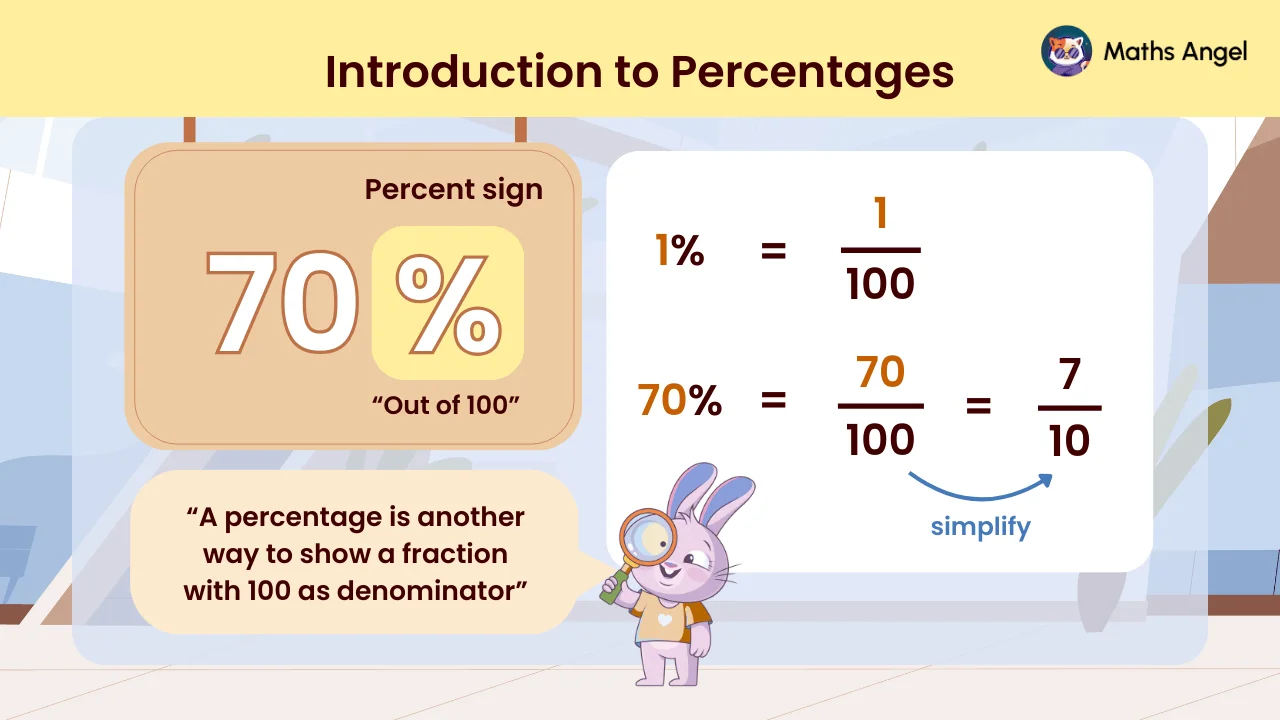
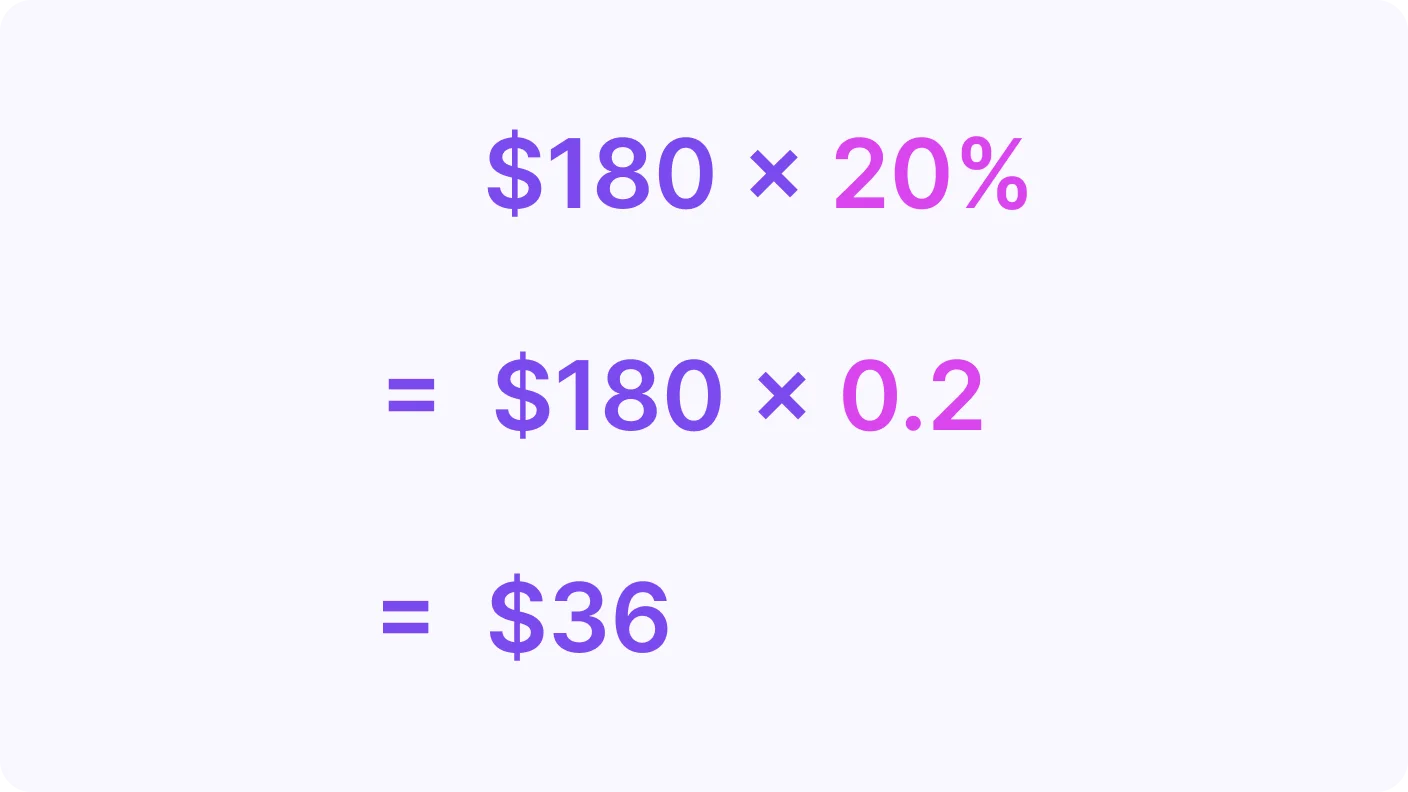
Percentage of a number is a part of it out of 100. To find it, change the percent to a decimal and multiply, so 20% of 180 is 0.2 × 180 = 36. As a shortcut, 10% of a number is just that number ÷ 10.
Video Lesson
Watch and learn the basics
🎬 Did this video explain it clearly?
Flashcards
Review key concepts visually
%20Percentage%20of%20a%20Number%20Formula.webp)
%20Percentage%20of%20a%20Number%20Examples.webp)
%20Percentage%20of%20a%20Number%20Application.webp)
%20Percentage%20of%20a%20Number%20Trick.webp)
The Percentage Formula
- Percentage of a number = original number × percentage
- Example: of
Finding a Percentage of an Amount
- Turn the percentage into a decimal or fraction, whichever is easier
- Example: of
Using Percentages in Real Life
- First, find the percentage value (e.g. of £ £36)
- Then add it for a tip or tax, or subtract it for a discount
Percentage Tricks ( and )
- of a number: move the decimal one place left
- of a number: move the decimal two places left
Practice Questions
Test your understanding
What is of 200?
Correct! 🎉 +10 pointsCorrect! 🎉 Worth 10 XPNot quite right
means 5 out of every 100, so as a decimal.
Multiply: .
A quick check: of 200 is 20, and is half of , which is 10.
What is of 160?
Correct! 🎉 +10 pointsCorrect! 🎉 Worth 10 XPNot quite right
of 160 is .
is two lots of , so .
In one step you could also write as 0.2 and calculate .
What is of 160?
Correct! 🎉 +20 pointsCorrect! 🎉 Worth 20 XPNot quite right
is the same as the fraction .
Divide by the denominator first: (that is ). Then multiply by the numerator: .
So of 160 is 120.
A table costs 180 and is on sale for off. How much do you save?
Correct! 🎉 +20 pointsCorrect! 🎉 Worth 20 XPNot quite right
The saving is of the full price, and as a decimal.
Multiply: .
The question asks how much you save, not how much you pay, so the answer is 54. (The sale price would be .)
A laptop costs 1800. It’s discounted by . How much do you save?
Correct! 🎉 +20 pointsCorrect! 🎉 Worth 20 XPNot quite right
of 1800 is .
is twelve lots of , so .
The question asks for the saving, so the answer is 216. (The price you would actually pay is .)
A bike originally costs 1200. There’s a discount. What is the new price?
Correct! 🎉 +30 pointsCorrect! 🎉 Worth 30 XPNot quite right
of 1200 is , so is .
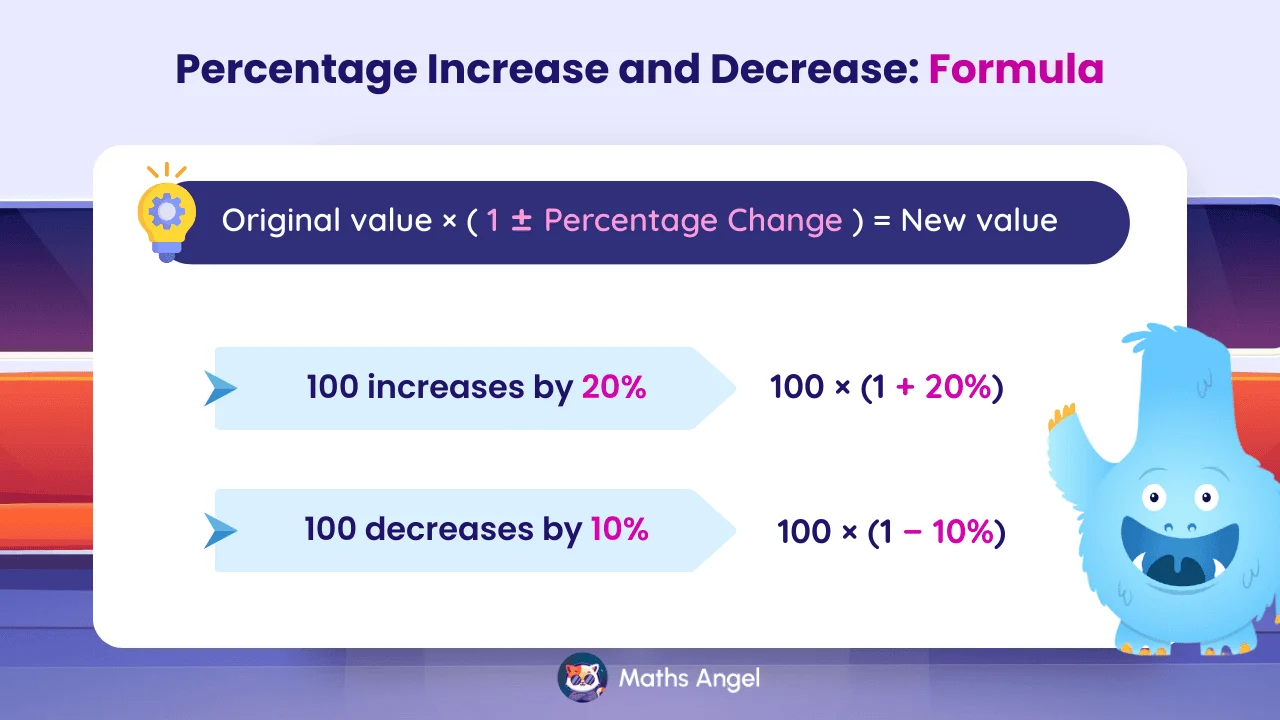
The price goes down, so subtract the discount: .
In one step, a decrease means paying of the price: .
Want to see the full working?
Interactive Activity
Drag the slider to visualise any percentage of a number as a part of the whole
Loading interactive widget...
Frequently asked questions
The questions students bump into most on this topic
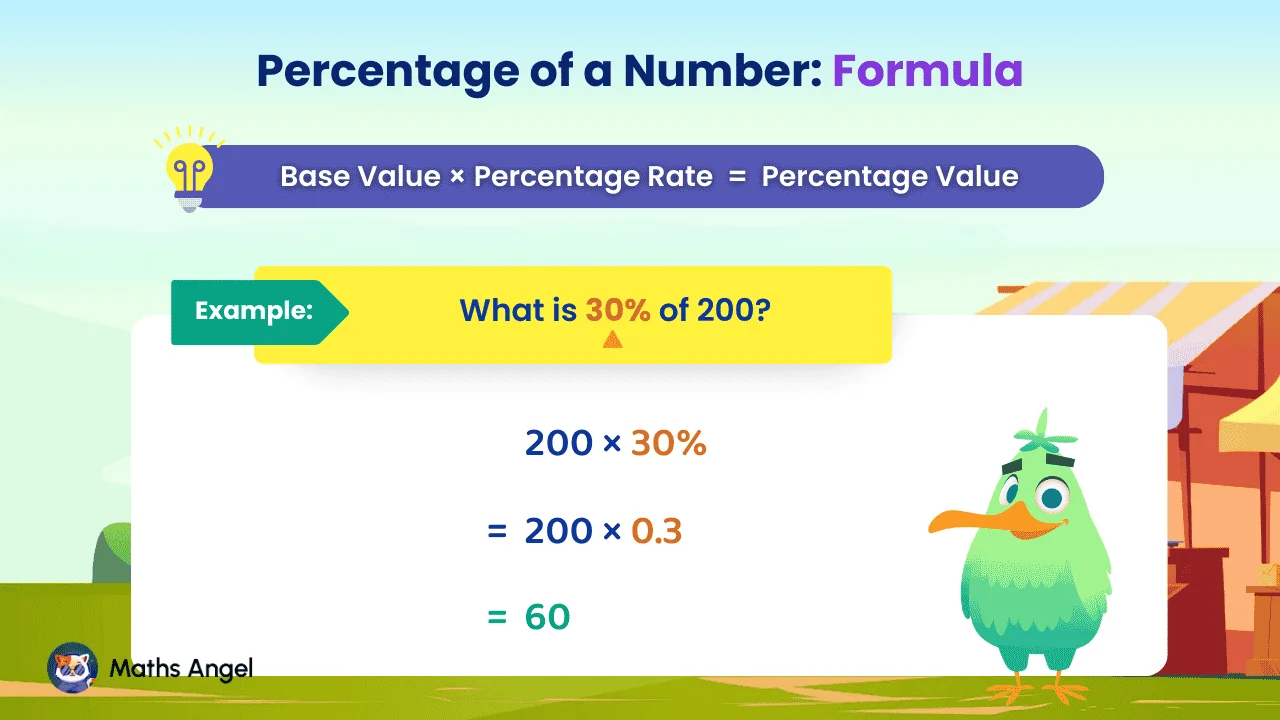
Write the percentage as a decimal and multiply: base value × percentage rate = percentage value. For 30% of 200, 30% is 0.3, and 200 × 0.3 = 60. For 60% of 150 kg, 150 × 0.6 = 90 kg. When the percentage is a simple fraction, such as 25% = 1/4, multiply by the fraction instead.
Divide by 100, which moves the decimal point two places to the left. So 30% is 0.3, 60% is 0.6, 25% is 0.25 and 5% is 0.05. Then multiply the number by that decimal: 5% of 200 is 200 × 0.05 = 10. Going the other way, multiply a decimal by 100 to get the percentage.
Move the decimal point one place to the left: 10% of 1,500 is 150, and 10% of 70 is 7. Then build other percentages from it: 20% is twice 10%, so 20% of 70 is 14 and 20% of 160 is 32; 5% is half of 10%. It works without a calculator, which is why it is worth learning.
Move the decimal point two places to the left: 1% of 1,500 is 15. Then multiply by the percentage you need. A laptop costs £1,500 with a 12% discount: 1% is £15, so 12% is 15 × 12 = £180, and that is the saving. Any awkward percentage can be built from 1%.
Yes, when the percentage is a simple fraction. 25% is one quarter, so 25% of 120 cm is 120 ÷ 4 = 30 cm; cross-cancelling 120 and 4 makes it quick. 50% is a half, 75% is three quarters, so 75% of 160 is 160 ÷ 4 × 3 = 120. Choose the decimal or the fraction, whichever is easier.
Find the percentage first, then add it for a tip or subtract it for a discount. A £180 bill with a 20% tip: 20% is 0.2, and 180 × 0.2 = £36, so you pay 180 + 36 = £216. A £1,200 bike with 15% off: 1% is £12, so 15% is £180, and the new price is 1,200 − 180 = £1,020.
What's next?
Found this one hard? Go one step back first. Feeling confident? Carry on to the next lesson.