
Finding the nth Term of a Linear Sequence
A linear sequence goes up by the same amount. The nth term of a linear sequence is a rule an + b that gives any term from its position. Here a is the common difference and b is first term − a, so 2, 5, 8, 11 has rule 3n − 1.
Video Lesson
Watch and learn the basics
🎬 Did this video explain it clearly?
Flashcards
Review key concepts visually
%20What%20Is%20a%20Linear%20Sequence%3F.webp)
%20How%20to%20Use%20the%20nth%20Term%20Rule.webp)
%20Practice%20Finding%20the%20nth%20Term.webp)
%20Is%20the%20Number%20in%20the%20Sequence%3F.webp)
Spotting a Linear Sequence
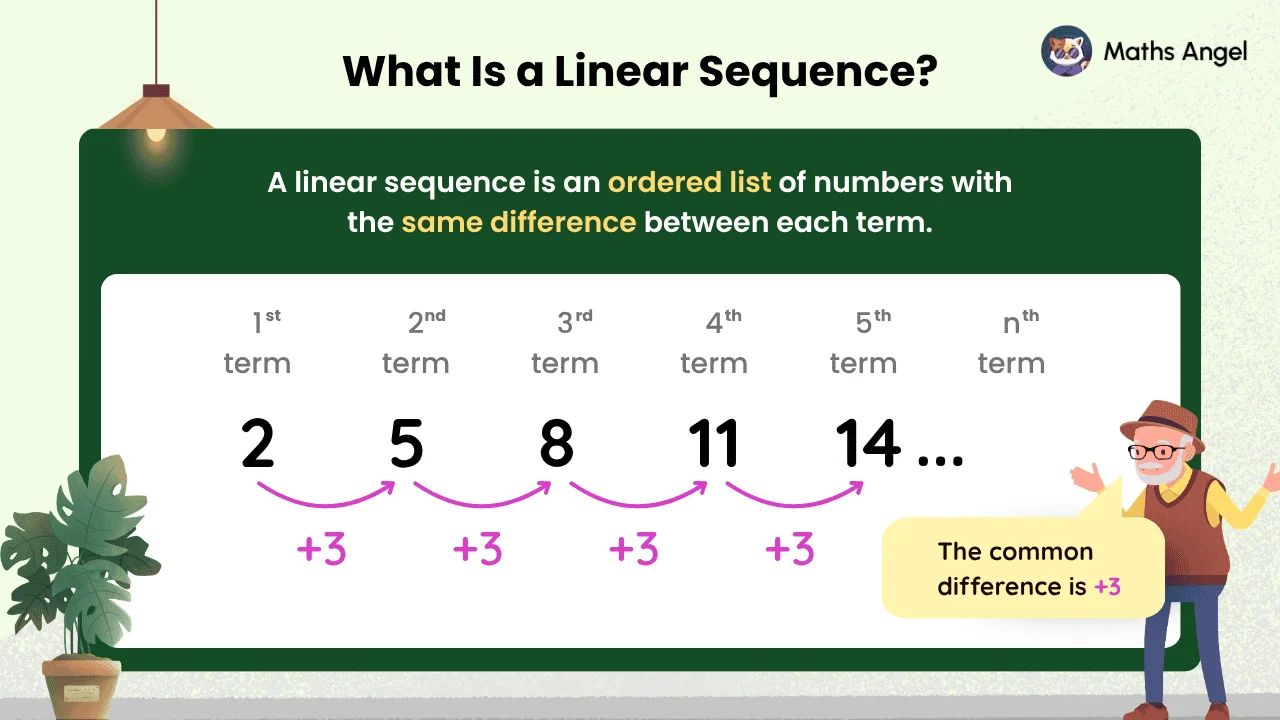
- A linear sequence has the same difference between each term.
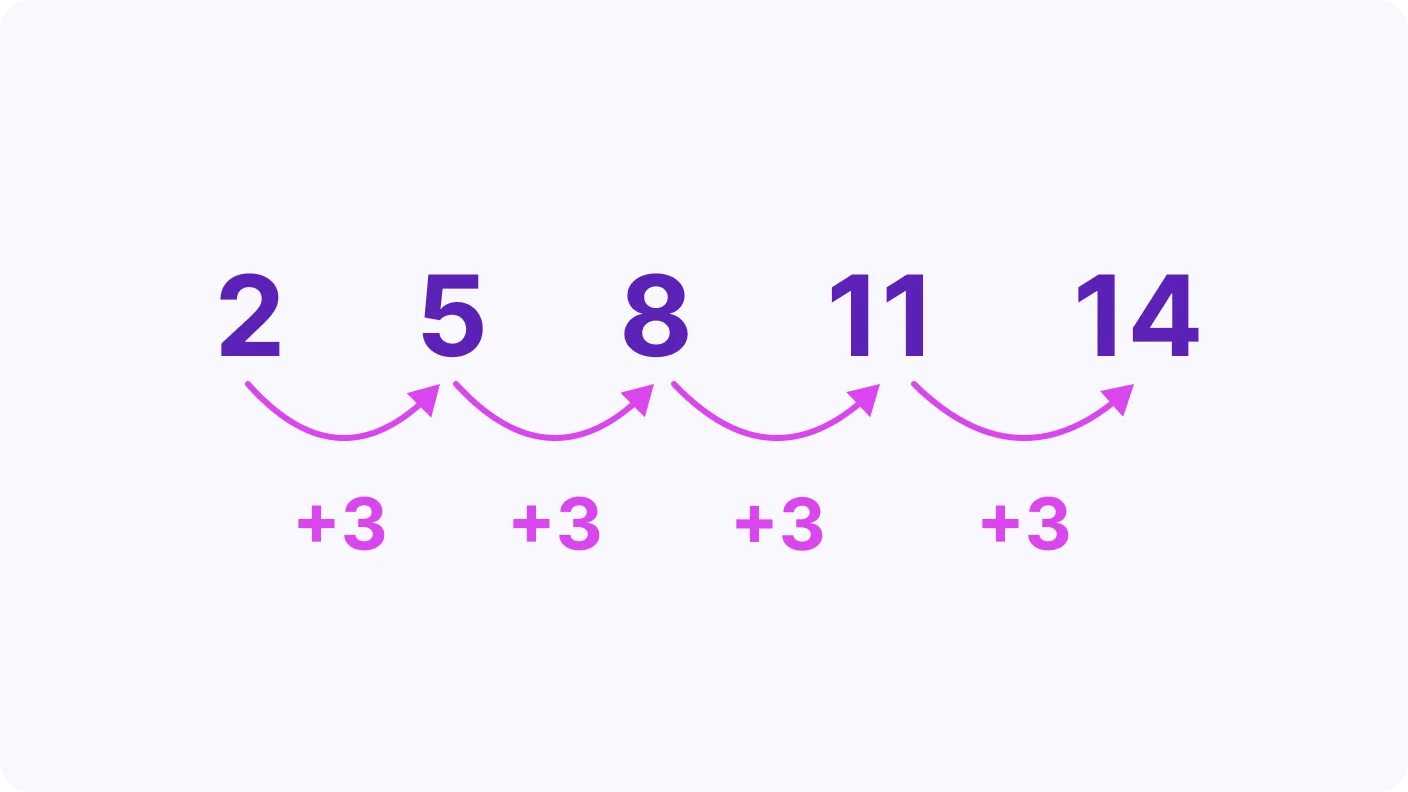
- For 2, 5, 8, 11, 14, you add 3 each time, so the common difference is +3.
Building the nth Term Rule
- The nth term rule has the form an + b, where a is the common difference and b is first term − a.
- For 5, 9, 13, 17, 21: and , giving the rule 4n + 1.
Finding Terms in a Decreasing Sequence
- A decreasing sequence has a negative common difference.
- For 20, 17, 14, 11, 8: and , giving the rule −3n + 23.
- To find the 100th term, put : −277.
Checking If a Number Is in a Sequence
- Set the nth term equal to the number and solve for n; it is in the sequence only when n is a positive whole number.
- 59 is in 5n − 1 , but 60 is not in 4n + 2 .
Practice Questions
Test your understanding
The nth term of a sequence is . Find the 5th term.
Correct! 🎉 +10 pointsCorrect! 🎉 Worth 10 XPNot quite right
Substitute into the rule: .
Multiply first, then subtract: .
So the 5th term is 29.
Remember means (not ), and the must be done after the multiplication, not before.
Find the nth term rule for the sequence
Correct! 🎉 +10 pointsCorrect! 🎉 Worth 10 XPNot quite right
The rule has the form .
The common difference is , so the rule starts with , which gives
Every term of our sequence is 4 more than that, and . So the nth term is .
Check: gives 6 and gives 12.
Note that is the first term minus , not the first term itself, and not minus the first term.
Find the 20th term of the sequence
Correct! 🎉 +20 pointsCorrect! 🎉 Worth 20 XPNot quite right
First find the rule. The common difference is .
Then , so the nth term is .
Substitute : .
So the 20th term is 137.
Watch the order when finding : it is , not .
Find the 15th term of the sequence
Correct! 🎉 +20 pointsCorrect! 🎉 Worth 20 XPNot quite right
The terms are decreasing, so the common difference is .
Then , so the nth term is .
Substitute : .
So the 15th term is .
Take care with the signs: subtracting a negative makes larger, and comes to , not 26. The answer stays negative.
A sequence has nth term . Is 41 a term in this sequence?
Correct! 🎉 +20 pointsCorrect! 🎉 Worth 20 XPNot quite right
Set the rule equal to the number: .
Undo the first: . Then undo the : .
Since is a positive whole number, 41 is in the sequence: it is the 18th term.
Check: .
Look at the sequence Is 100 a term in this sequence?
Correct! 🎉 +30 pointsCorrect! 🎉 Worth 30 XPNot quite right
First find the rule. The common difference is , and , so the nth term is .
Set it equal to the number: , so and
Since is not a whole number, 100 is not a term in the sequence.
The 14th term is and the 15th is , so 100 falls between two terms. You cannot round : there is no '14.57th term'.
Want to see the full working?
Interactive Activity
Work out a and b to build the nth term rule for each sequence.
Loading interactive widget...
Finding the nth Term of a Linear Sequence frequently asked questions
The questions students bump into most on this topic
The nth term means a rule that gives you any term in a sequence from its position. Instead of listing every value, you use the rule to find the term you want. For a linear sequence, this rule takes the form an + b.
The nth-term formula for a linear sequence is an + b. Here, a is the common difference between consecutive terms. The letter b is the adjustment, which equals the first term minus a. Once you know a and b, substitute a position for n to find any term.
The common difference is the fixed amount you add or subtract between terms. It stays the same across a linear sequence. For example, in 2, 5, 8, the common difference is 3, because each term goes up by 3. It is the value of a in the rule.
Because b is the adjustment, not the starting value. You find b by subtracting the common difference a from the first term. So b equals the first term minus a. Assuming b is simply the first term is one of the most common mistakes.
You use the same method, but the common difference is negative. When the terms get smaller, a is negative. For example, in 20, 17, ..., the common difference is −3. Then b = 20 − (−3) = 23, because subtracting a negative means adding. So the rule is −3n + 23.
It means the number you tested is not in the sequence. When you solve for n, it must be a positive whole number. That is because terms only exist at whole positions. For example, n = 14.5 has no matching term, so the number is not in the sequence.