
Quadratic Sequence and Geometric Sequence
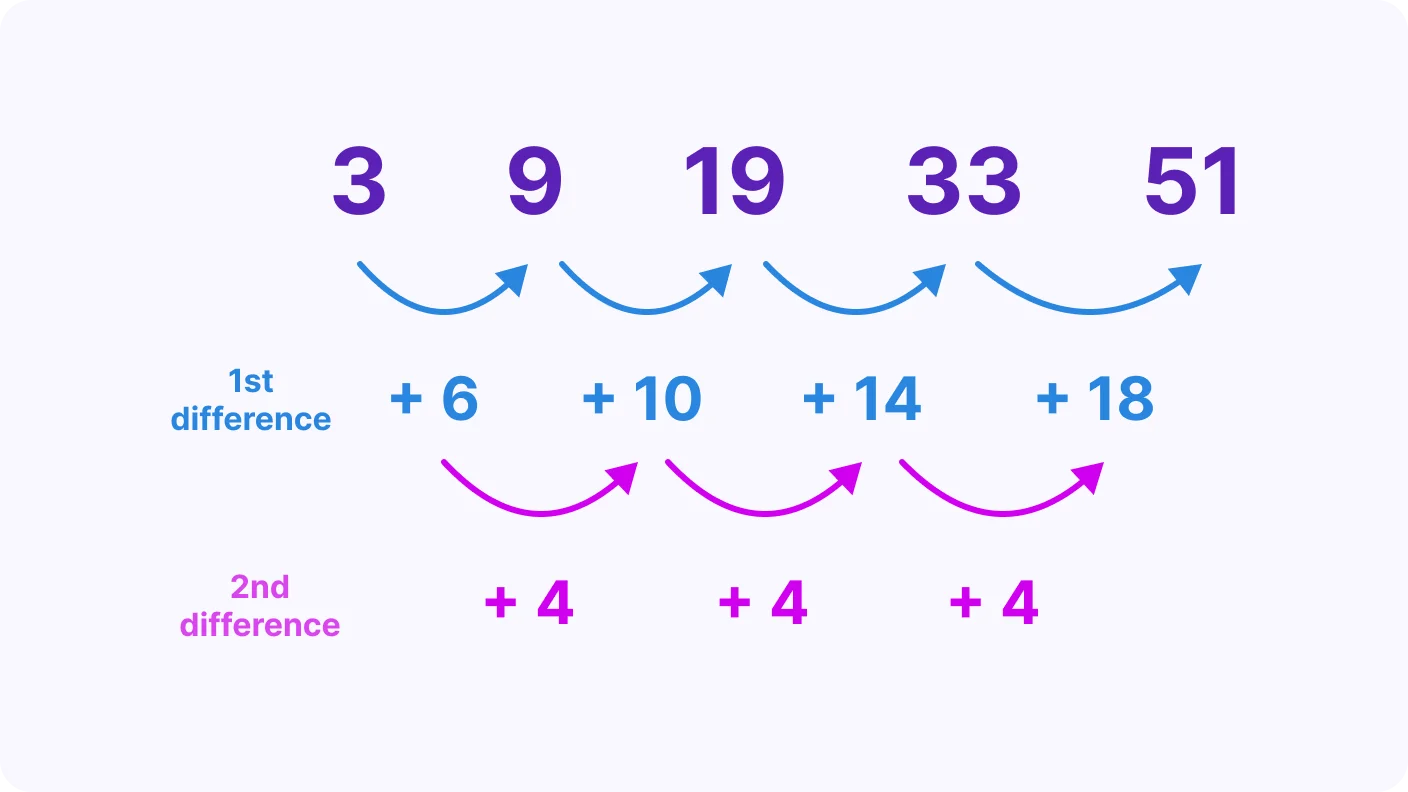
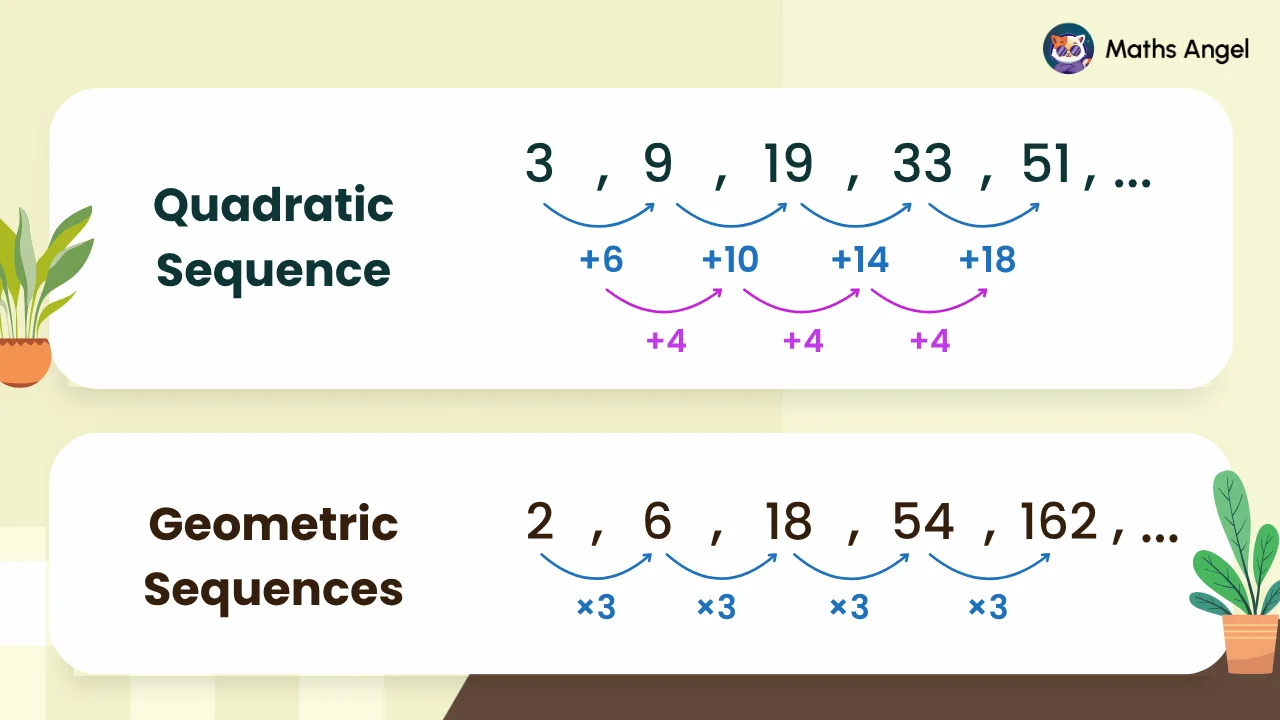
Quadratic sequences have a constant second difference. In 3, 9, 19, 33, 51 the gaps +6, +10, +14 climb by +4. Geometric sequences instead multiply by a fixed common ratio, like 2, 6, 18 with r = 3.
Video Lesson
Watch and learn the basics
🎬 Did this video explain it clearly?
Flashcards
Review key concepts visually
%20Finding%20the%20Next%20Terms%20of%20a%20Quadratic%20Sequence.webp)
%20What%20Is%20a%20Geometric%20Sequence.webp)
%20Finding%20Any%20Term%20of%20a%20Geometric%20Sequence.webp)
Finding the Next Terms of a Quadratic Sequence
- A quadratic sequence has a constant second difference.
- In 3, 9, 19, 33, 51 the first differences are +6, +10, +14, +18, so the second difference is +4.
- To find the next term, add the next first difference : .
What Is a Geometric Sequence?
- A geometric sequence multiplies by the same number each time, the common ratio (r).
- 2, 6, 18, 54, 162 has , and the ratio can be a fraction like .
Finding Any Term of a Geometric Sequence
- Use the nth term formula (a = first term, r = common ratio, n = term number).
- For 2, 6, 18, 54, … the 5th term is 2 × 3⁴ .
Practice Questions
Test your understanding
What is the common ratio of the geometric sequence 5, 10, 20, 40, ...?
Correct! 🎉 +10 pointsCorrect! 🎉 Worth 10 XPNot quite right
In a geometric sequence, divide each term by the term before it to find the common ratio .
, and .
The ratio is the same every time, so the common ratio is 2.
Find the next term in the geometric sequence 64, 32, 16, 8, ...
Correct! 🎉 +10 pointsCorrect! 🎉 Worth 10 XPNot quite right
Find the common ratio by dividing a term by the one before it: .
Check it is the same all the way along: and , so the ratio really is constant at .
The ratio is less than 1, so each term is half the one before and the terms get smaller.
Multiply the last term by the ratio: .
So the next term is 4.
Find the constant second difference of the quadratic sequence 3, 4, 7, 12, 19, ...
Correct! 🎉 +20 pointsCorrect! 🎉 Worth 20 XPNot quite right
A quadratic sequence has a constant second difference, so start with the first differences.
, , , , giving the row .
Now difference that row: , , .
So the second difference is constant at 2.
Second difference means the difference between the first differences. It is not one of the first differences itself, and it is not the gap between terms two places apart.
Find the next term in the quadratic sequence 5, 8, 14, 23, 35, ...
Correct! 🎉 +20 pointsCorrect! 🎉 Worth 20 XPNot quite right
First find the first differences: , , , .
These are not constant, so difference them again: , , . The second difference is 3.
Because the gaps grow by 3 each time, the next first difference is .
Add that to the last term: .
So the next term is 50. Note that the second difference is added to the gap, not to the term itself.
A geometric sequence has first term 3 and common ratio 2. What is the 6th term?
Correct! 🎉 +20 pointsCorrect! 🎉 Worth 20 XPNot quite right
The nth term of a geometric sequence is , where is the first term and is the common ratio.
Here , and , so the 6th term is .
, so .
So the 6th term is 96.
You can check by listing the terms: 3, 6, 12, 24, 48, 96. Getting from the 1st term to the 6th takes five multiplications, which is why the exponent is and not .
The first five terms of a quadratic sequence are 4, 7, 14, 25, 40. Find the 7th term.
Correct! 🎉 +30 pointsCorrect! 🎉 Worth 30 XPNot quite right
Find the first differences: , , , .
Difference that row again: , , , so the second difference is constant at 4.
The gap grows by 4 every time. The next gap is , so the 6th term is .
The gap after that is , so the 7th term is .
So the 7th term is 82. The gap must be increased again for the second step - it does not stay at 19.
Want to see the full working?
Interactive Activity
Use the difference method to spot a quadratic sequence
Loading interactive widget...
Quadratic Sequence and Geometric Sequence frequently asked questions
The questions students bump into most on this topic
You know a sequence is quadratic when its second difference is constant. First, subtract each term from the next to get the first differences. Then subtract each first difference from the next to get the second differences. If every second difference is the same, the sequence is quadratic.
To find the common ratio, divide any term by the term immediately before it. For example, in 2, 6, 18, 54, dividing 6 by 2 gives 3, and 18 by 6 also gives 3. If every division gives the same answer, that answer is the common ratio r.
In a geometric sequence, r stands for the common ratio. It is the fixed number you multiply one term by to reach the next term. You find r by dividing any term by the one before it. The common ratio can be a whole number or a decimal.
Yes, the common ratio can be a decimal. For example, in the sequence 96, 48, 24, 12, each term divided by the one before gives 0.5, so the common ratio is 0.5. A decimal ratio less than 1 makes each term smaller than the last.
A quadratic sequence has a constant second difference, so you extend it by adding. A geometric sequence has a constant common ratio, so you extend it by multiplying. In short, quadratic sequences are built on differences between terms, while geometric sequences are built on repeated multiplication.
Multiplying term by term works for the next term, but it is slow for a term far along, such as the 20th. The nth term formula, a × rⁿ⁻¹, lets you jump straight to any term. You substitute the first term, the common ratio and the position n.