Percentage Increase and Decrease
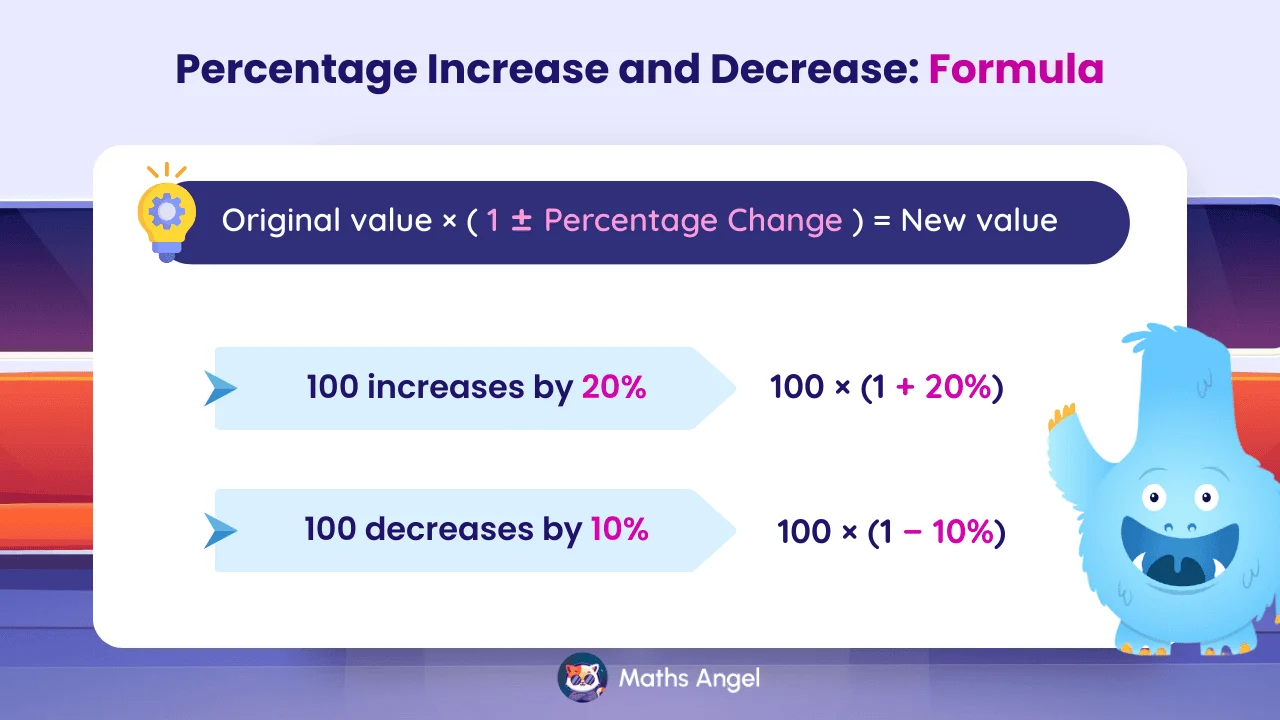
Percentage increase and decrease use one formula: new value = original × (1 ± percentage change). Add to increase, subtract to decrease. A reverse percentage divides to find the original value.
Video Lesson
Watch and learn the basics
🎬 Did this video explain it clearly?
Flashcards
Review key concepts visually
%20Percentage%20Increase%20and%20Decrease%20-%20Formula.webp)
%20Percentage%20Increase%20and%20Decrease%20-%20Examples.webp)
%20Reverse%20Percentage%20-%20Finding%20the%20Original%20Value.webp)
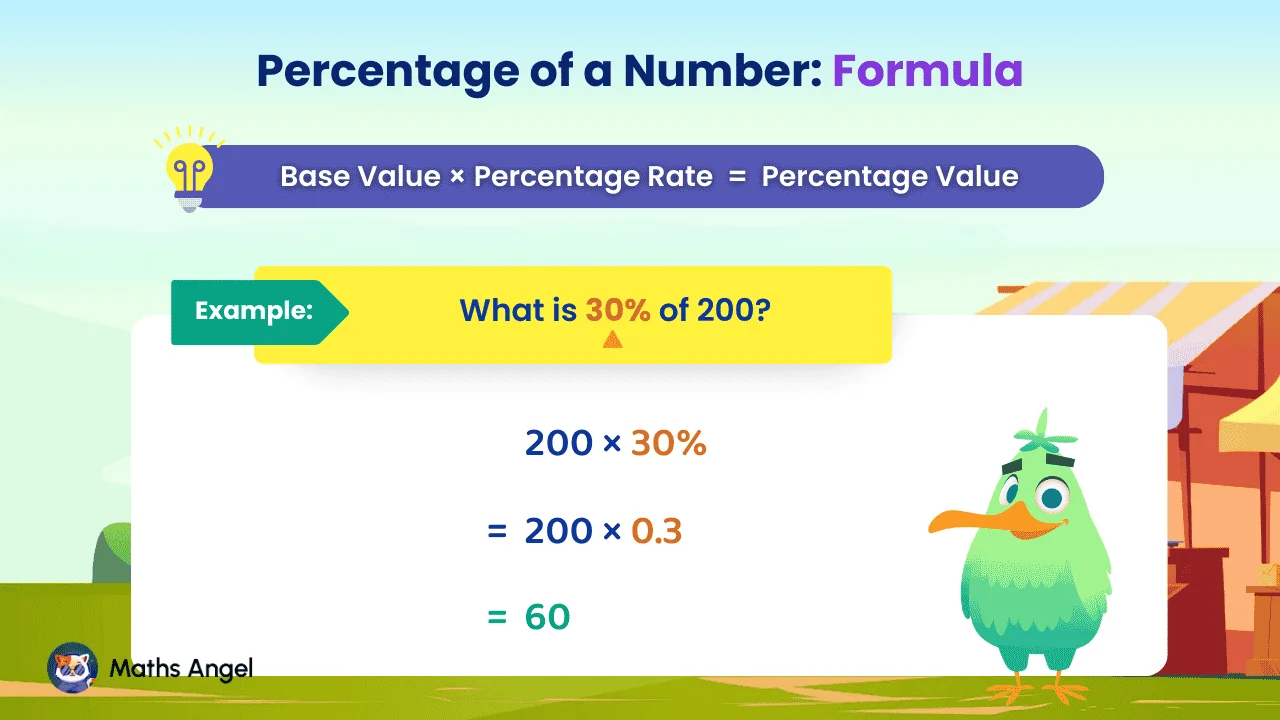
The Percentage Formula
- New value = original value × (1 ± percentage change)
- Use “+” for an increase, and “−” for a decrease
Calculating Percentage Increase and Decrease
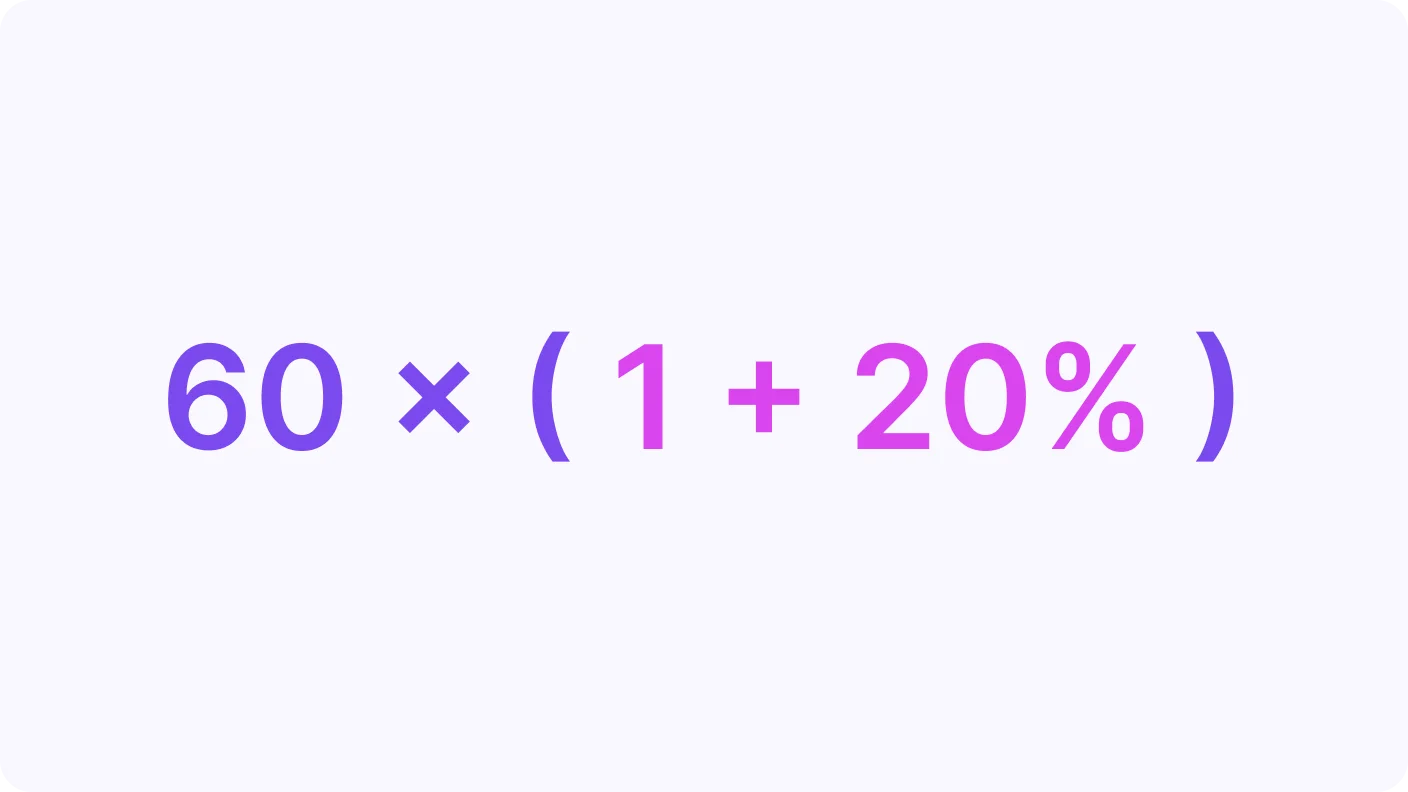
- Increase: 60 increased by
- Decrease: 90 with
Finding the Original Value (Reverse Percentage)
- Use the same formula, but the original value is the unknown
- Solve it by dividing (e.g. original , so
Practice Questions
Test your understanding
A book costs £50. Its price increases by . What is the new price?
Correct! 🎉 +10 pointsCorrect! 🎉 Worth 10 XPNot quite right
Use the percentage increase formula: New Value = Original Value (1 + Percentage Change).
As a decimal, is , so the multiplier is .
New price: , so the book now costs £55.
You can check it: of £50 is £5, and £50 + £ £55.
A table originally cost £200, and it's now on sale for off. What's the sale price?
Correct! 🎉 +10 pointsCorrect! 🎉 Worth 10 XPNot quite right
Use the percentage decrease formula: New Value = Original Value (1 − Percentage Change).
As a decimal, is , so the multiplier is .
Sale price: , so the table costs £140.
You can check it: of £200 is £60, and £200 − £ £140.
A cinema ticket costs £20. There's a student discount. What do you pay?
Correct! 🎉 +20 pointsCorrect! 🎉 Worth 20 XPNot quite right
Use the percentage decrease formula: New Value = Original Value (1 − Percentage Change).
As a decimal, is , so the multiplier is .
Price paid: , so you pay £17.
Or work out the discount first: of £20 is £3, and £20 − £ £17. Take care with : it is 0.85, not 0.95.
A game is advertised as " off" and now costs £60. What was the original price?
Correct! 🎉 +20 pointsCorrect! 🎉 Worth 20 XPNot quite right
This is a reverse percentage: the £60 is the price after the discount, not the original.
Start with New Value = Original Value (1 − Percentage Change). The multiplier is , so .
To undo the multiplication, divide: , so the original price was £80.
Check: of £80 is £20, and £80 − £ £60.
A laptop originally cost £600. Its price increased by . What is the new price?
Correct! 🎉 +20 pointsCorrect! 🎉 Worth 20 XPNot quite right
Use the percentage increase formula: New Value = Original Value (1 + Percentage Change).
As a decimal, is , so the multiplier is (not 1.2, which would be a increase).
New price: , so the laptop now costs £672.
Check: of £600 is £72, and £600 + £ £672.
A jacket is advertised as " off", and you also get an extra student discount on the reduced price. If the original price was £100, how much do you pay in total?
Correct! 🎉 +30 pointsCorrect! 🎉 Worth 30 XPNot quite right
Apply the two discounts one after the other, not added together.
First the off: , so the price drops to £70.
Then the off that reduced price: .
So you pay £63. Taking off in one go would give £60, which is wrong: the second discount applies to £70, not to the original £100.
Want to see the full working?
Interactive Activity
Visualise and calculate percentage increase and decrease
Loading interactive widget...
Frequently asked questions
The questions students bump into most on this topic
One formula: new value = original value × (1 ± percentage change). Add the percentage for an increase and subtract it for a decrease. So 100 increased by 20% is 100 × (1 + 0.2) = 100 × 1.2 = 120, and 100 decreased by 10% is 100 × (1 − 0.1) = 100 × 0.9 = 90. The number in brackets is the multiplier.
Multiply by 1 plus the percentage as a decimal. Your maths score was 60 and goes up by 20%: 60 × 1.2 = 72. A 10% increase means × 1.1, so £50 becomes £55; a 5% increase means × 1.05, so £100 becomes £105; a 2.5% pay rise means × 1.025. One multiplication does the whole job.
Subtract the percentage from 1 to get the multiplier, then multiply. A £90 jacket has 30% off: 1 − 0.3 = 0.7, and 90 × 0.7 = £63. A 15% student discount on a £20 cinema ticket is 20 × 0.85 = £17. The multiplier is always less than 1 for a decrease.
Change the percentage to a decimal by dividing by 100, then add it to 1 for an increase or subtract it from 1 for a decrease. 20% is 0.2, so a 20% increase is × 1.2 and a 20% decrease is × 0.8. 30% off is × 0.7; 12% more is × 1.12. Multiply the original value by that number.
Use the same formula and solve backwards: divide the new value by the multiplier. You paid £36 for a concert ticket after a 40% discount. The multiplier is 1 − 0.4 = 0.6, so original price × 0.6 = 36, and the original price is 36 ÷ 0.6 = £60. No new formula is needed; you divide instead of multiply.
Use the formula twice; do not add the percentages. A £100 jacket has 30% off, then an extra 10% student discount on the reduced price: 100 × 0.7 = £70, then 70 × 0.9 = £63. Adding the discounts to 40% would give £60, which is wrong, because the 10% is taken off £70, not £100.
What's next?
Found this one hard? Go one step back first. Feeling confident? Carry on to the next lesson.