Introduction to Ratios
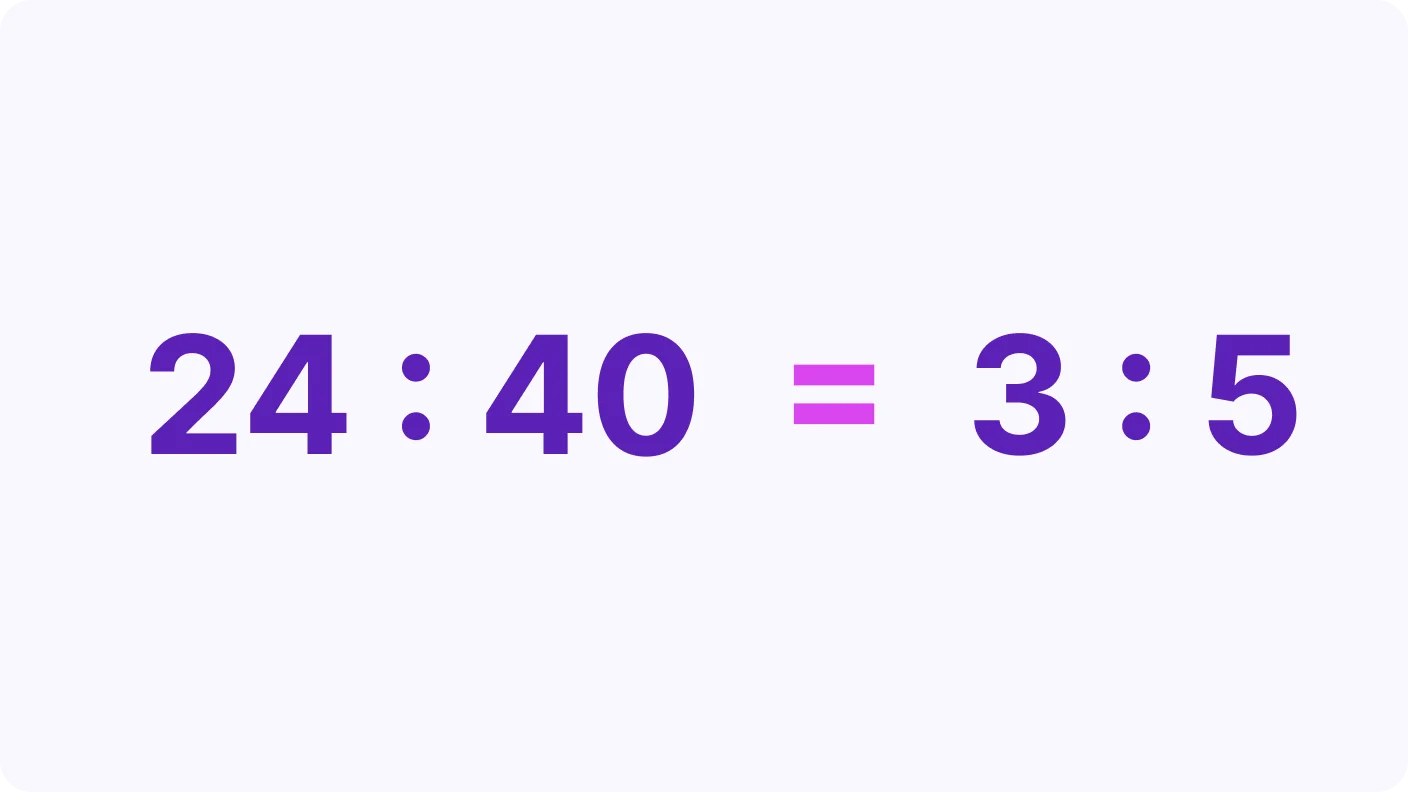
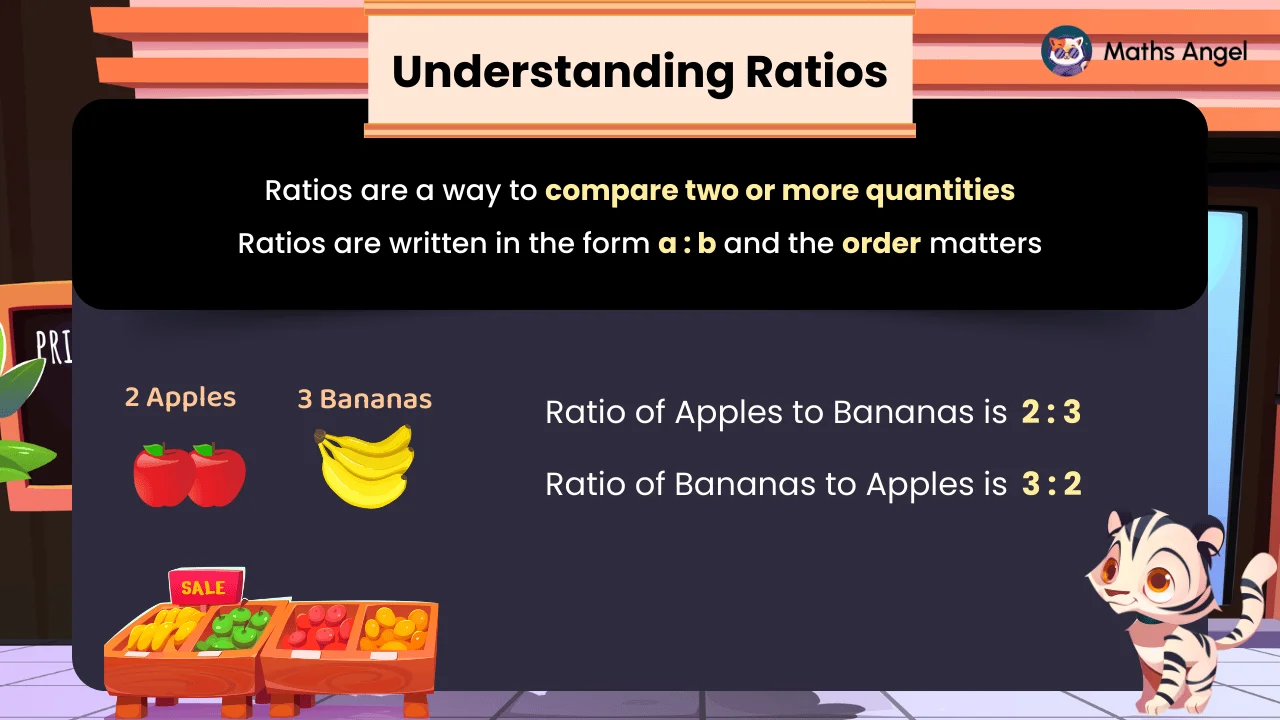
A ratio compares quantities to show their relative sizes, written as a : b. For example, 2 apples to 3 bananas is 2 : 3. To simplify, divide both parts by the same number, so 24 : 40 becomes 3 : 5.
Video Lesson
Watch and learn the basics
🎬 Did this video explain it clearly?
Flashcards
Review key concepts visually
%20Ratios%20Definition%20and%20Examples.webp)
%20Calculating%20with%20Ratios%20(Finding%20Parts).webp)
%20Calculating%20with%20Ratios%20(Dividing%20a%20Whole).webp)
%20Simplifying%20and%20Expanding%20Ratios.webp)
What Is a Ratio?
- A ratio compares quantities and is written as a : b.
- The order matters (apples : bananas = 2 : 3, but bananas : apples = 3 : 2).
Working with Ratio 5:2
- A ratio of 5 : 2 means for every 5 parts of flour, there are 2 parts of sugar.
- To find one part, divide by 5 to get per part.
- Multiply by 2 to get of sugar needed.
Sharing a Whole in a Ratio
- Add the numbers in the ratio to find the total parts. For example, 7:3 means parts.
- Each part = total amount ÷ total parts. For example, £200 total divided by 10 parts = £20 per part.
- One person gets 7 parts, so £ £140. The other person gets 3 parts, so £ £60.
Simplifying and Expanding Ratios
- To simplify, divide every part by the same number. For example, 24:40 can be simplified by dividing both by 8 to get 3:5.
- To expand, multiply every part by the same number. For example, 3:7 can be expanded by multiplying both by 5 to get 15:35.
Practice Questions
Test your understanding
Simplify the ratio to its simplest form.
Correct! 🎉 +10 pointsCorrect! 🎉 Worth 10 XPNot quite right
The highest common factor of 18 and 24 is 6.
Divide both parts by 6: and .
So the ratio in its simplest form is .
If the ratio of apples to oranges is , how would you write the ratio of oranges to apples?
Correct! 🎉 +10 pointsCorrect! 🎉 Worth 10 XPNot quite right
The order of a ratio follows the order the quantities are named.
Apples to oranges is , so oranges to apples puts the oranges first: .
If £300 is split between two people in a ratio of , how much does the first person receive?
Correct! 🎉 +20 pointsCorrect! 🎉 Worth 20 XPNot quite right
The ratio has parts in total.
One part is £ £60.
The first person gets 3 parts: 3 × £ £180.
The ratio of pencils to pens in a box is . If there are 40 items in total, how many pencils are there?
Correct! 🎉 +20 pointsCorrect! 🎉 Worth 20 XPNot quite right
The ratio has parts in total.
One part is items.
Pencils take 5 parts: pencils (and pens take .
The ratio of red to blue marbles is . If there are 36 red marbles, how many blue marbles are there?
Correct! 🎉 +20 pointsCorrect! 🎉 Worth 20 XPNot quite right
The 4 red parts represent 36 marbles, so one part is marbles.
Blue takes 5 parts: blue marbles.
The ratio of adults to children at an event is . If there are 150 adults, how many people are there in total?
Correct! 🎉 +30 pointsCorrect! 🎉 Worth 30 XPNot quite right
The 5 adult parts represent 150 adults, so one part is people.
The total is parts: people.
Want to see the full working?
Interactive Activity
Simplifying and expanding ratios by finding equivalent forms
Loading interactive widget...
Frequently asked questions
The questions students bump into most on this topic
A ratio compares two or more quantities and shows their relative sizes, written with a colon, a : b. With 2 apples and 3 bananas, the ratio of apples to bananas is 2 : 3. The order matters: bananas to apples is 3 : 2. Ratios can be simplified and expanded like fractions without changing what they mean.
Find the value of one part, then multiply. A cake needs flour and sugar in the ratio 5 : 2, so 5 parts of flour go with 2 parts of sugar. With 300 g of flour, the 5 parts are 300 g, so one part is 300 ÷ 5 = 60 g. The sugar is 2 parts: 2 × 60 = 120 g.
Add the parts, divide the amount by that total to find one part, then multiply by each person’s parts. To share £200 in the ratio 7 : 3: there are 10 parts, so one part is £200 ÷ 10 = £20; you get 7 × £20 = £140 and your friend 3 × £20 = £60. Check: £140 + £60 = £200.
Divide every part by the same number, and repeat until the parts share no factor but 1. For 24 : 40, divide by 4 to get 6 : 10, then by 2 to get 3 : 5. Expanding is the reverse: multiply every part by the same number, so 3 : 7 times 5 is 15 : 35. The numbers change but the ratio stays the same.
24 : 36 simplifies to 2 : 3, because both numbers divide by 12. The same method works for any pair: 8 : 12 is also 2 : 3, 6 : 8 is 3 : 4, and 18 : 20 is 9 : 10. Find the biggest number that divides into both parts and divide each part by it.
What's next?
Found this one hard? Go one step back first. Feeling confident? Carry on to the next lesson.