Simple Interest and Compound Interest
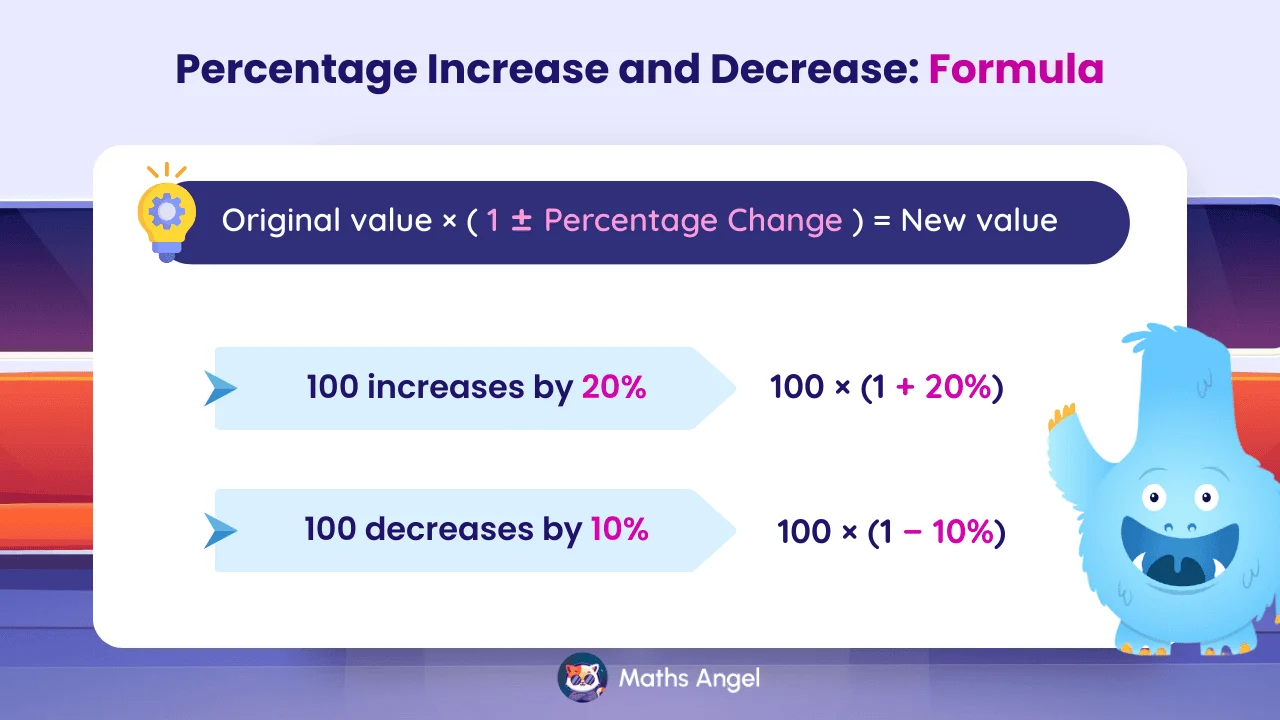
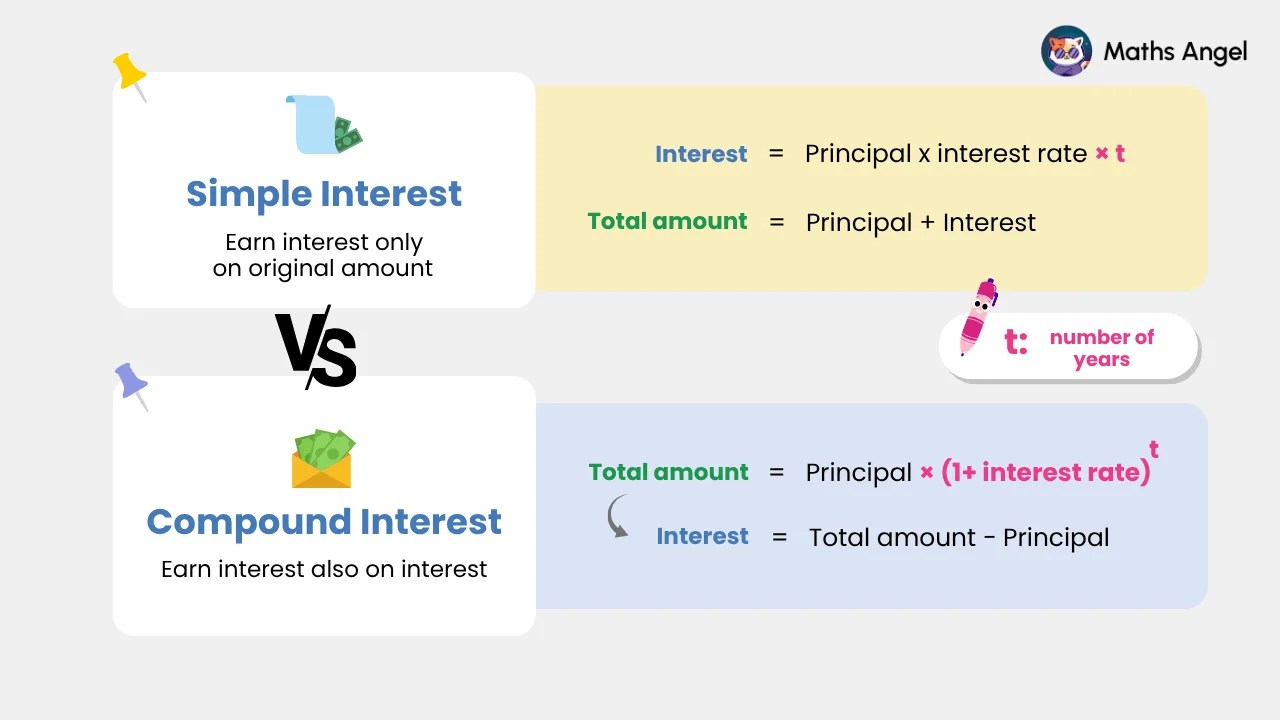
Simple interest is worked out only on the original amount, so £100 at 5% earns £5 a year. Compound interest also pays interest on the interest already added, so your money grows faster: the compound interest formula is total = principal × (1 + rate)ᵗ.
Video Lesson
Watch and learn the basics
🎬 Did this video explain it clearly?
Flashcards
Review key concepts visually
%20Simple%20Interest.webp)
%20Compound%20Interest.webp)
%20Simple%20vs%20Compound%20Interest.webp)
How to Calculate Simple Interest?
- Interest = Principal × rate × time, calculated on the original amount only.
- The total amount = Principal + Interest, since the principal stays the same each year.
How to Calculate Compound Interest?
- The total amount is calculated using Principal × (1 + rate)ᵗ.
- Interest is added to the principal each year, so the amount keeps increasing.
- The interest is calculated using Interest = Total − Principal.
Simple and Compound Compared
- Simple interest increases by the same amount each year.
- Compound interest increases faster over time because interest is added to the total.
- Compound interest is commonly used by banks.
Practice Questions
Test your understanding
You invest £200 in a bank offering simple interest annually. How much total interest will you earn after 5 years?
Correct! 🎉 +10 pointsCorrect! 🎉 Worth 10 XPNot quite right
With simple interest, the same interest is earned on the original £200 every year.
One year's interest: .
Over 5 years: .
The total interest is £40. Note that of £200 is £8 a year, not a flat £4, and that the question asks for the interest earned, not the final balance: the account would hold .
A bank offers a annual simple interest rate. If you invest £300 for 3 years, how much total interest will you earn?
Correct! 🎉 +10 pointsCorrect! 🎉 Worth 10 XPNot quite right
With simple interest, each year's interest is worked out on the original £300.
One year's interest: .
Over 3 years: .
The total interest is £36. Two things to watch: multiply by all 3 years, and give the interest, not the final balance of . (If the interest had been compound, the balance would be , so £37.46 of interest, slightly more.)
You invest £500 in a bank that offers compound interest annually. How much total amount will you have after 2 years?
Correct! 🎉 +20 pointsCorrect! 🎉 Worth 20 XPNot quite right
With compound interest the balance is multiplied by each year.
After year 1: .
After year 2: .
In one step: .
The total amount is £551.25, the whole balance, not the £51.25 of interest on its own. Compare this with simple interest, which would add £25 twice to give £550. Compounding earns an extra £1.25 because year 2's interest is worked out on £525, not £500.
A bank offers a annual simple interest rate. How much interest would you earn on a £1000 investment over 4 years, and what would the total amount be?
Correct! 🎉 +20 pointsCorrect! 🎉 Worth 20 XPNot quite right
With simple interest, each year's interest is worked out on the original £1000.
One year's interest: .
Over 4 years: .
The question also asks for the total amount, so add the interest to the principal: .
So the answer is £200 interest, £1200 total. Both parts must be right: multiply by all 4 years, and remember to add the interest on to the £1000 at the end.
You deposit £500 in a bank offering a annual simple interest rate. How much total amount will you have after 4 years?
Correct! 🎉 +20 pointsCorrect! 🎉 Worth 20 XPNot quite right
With simple interest, each year's interest is worked out on the original £500.
One year's interest: .
Over 4 years: .
The question asks for the total amount, so add this to the deposit: .
The total amount is £620. Watch out for stopping at the interest (£120), for using only one year's interest, and for compounding: , which is what a compound account would pay.
You invest £200 in a bank offering a annual compound interest rate. How much total amount will you have after 2 years?
Correct! 🎉 +30 pointsCorrect! 🎉 Worth 30 XPNot quite right
With compound interest the balance is multiplied by each year:
After year 1: .
After year 2: .
The total amount is £220.50, the balance in the account, not the £20.50 of interest on its own. Simple interest would add £10 twice to give exactly £220. The extra 50p is the interest earned on year 1's interest, which is what makes it compound.
Want to see the full working?
Interactive Activity
Compare how simple interest and compound interest grow your money over time
Loading interactive widget...
Frequently asked questions
The questions students bump into most on this topic
Simple interest is worked out on the original amount only, so you earn the same amount every year. Invest £100 at 5% and you earn £5 a year: over 3 years that is 3 × £5 = £15, and you end with £115. In GCSE maths it is the quick way to find interest over several years.
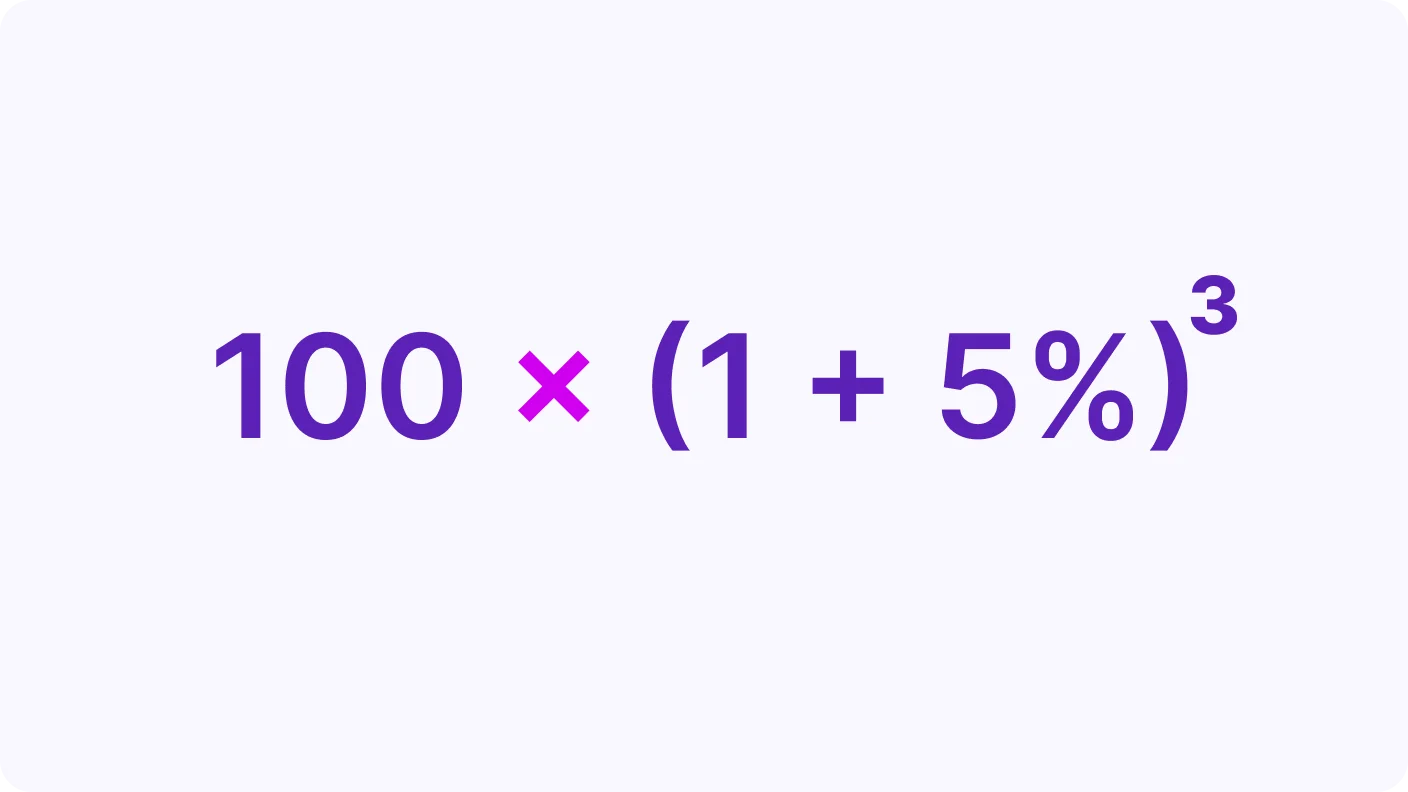
Compound interest pays interest on the interest you have already earned, not just on the original amount. With £100 at 5%, the first year’s £5 is added, so the second year you earn 5% of £105, and so on. After 3 years you have about £115.76 instead of £115. It is the kind banks actually use, and the kind GCSE questions ask about.
Simple interest uses the original amount every year, so it grows by the same £5 each time. Compound interest adds each year’s interest to the balance, so the next year’s interest is worked out on a larger amount and the growth speeds up. Over 3 years on £100 at 5% that is £15 against £15.76, and the gap widens every year.
Work out one year’s interest, principal × rate, then multiply by the number of years. Invest £200 at 4% for 5 years: one year is 200 × 0.04 = £8, so 5 years is 8 × 5 = £40. The total amount is the principal plus the interest, £240. The principal never changes.
Find the total first: total = principal × (1 + rate) to the power of the number of years. For £100 at 5% for 3 years, total = 100 × 1.05³ = £115.76. Then subtract the principal to get the interest: £15.76. For £1,000 at 6% for 2 years, total = 1,000 × 1.06² = £1,123.60.
It depends which side you are on. For savings it is good: your money grows faster every year, so starting early matters. For borrowing it is bad: a loan or credit card that compounds grows the same way, so the debt gets bigger the longer it is left. Either way, the formula in question 5 tells you exactly how much.
What's next?
Found this one hard? Go one step back first. Feeling confident? Carry on to the next lesson.