Tally Marks, Bar Charts, Tables
Tally marks count data as you collect it, grouped in fives. Bar charts then compare the groups, where each bar's height shows its value. Tables tidy the counts into rows, pairing each category with its total count.
Video Lesson
Watch and learn the basics
🎬 Did this video explain it clearly?
Flashcards
Review key concepts visually
%20Tally%20Mark%20Chart.webp)
%20Bar%20Charts.webp)
%20Tables.webp)
%20Tally%20Marks%2C%20tables%2C%20and%20Bar%20Charts.webp)
What Are Tally Mark Charts?
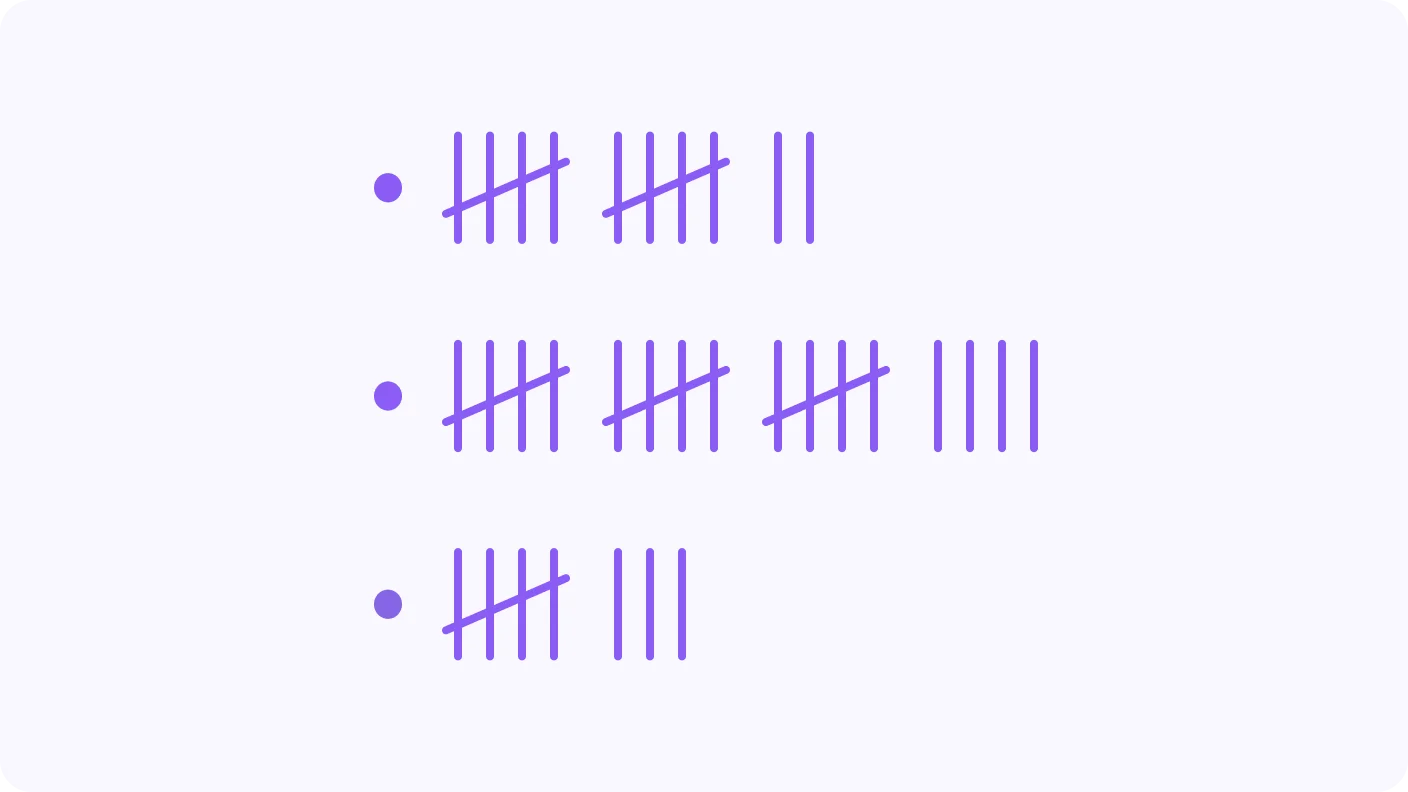
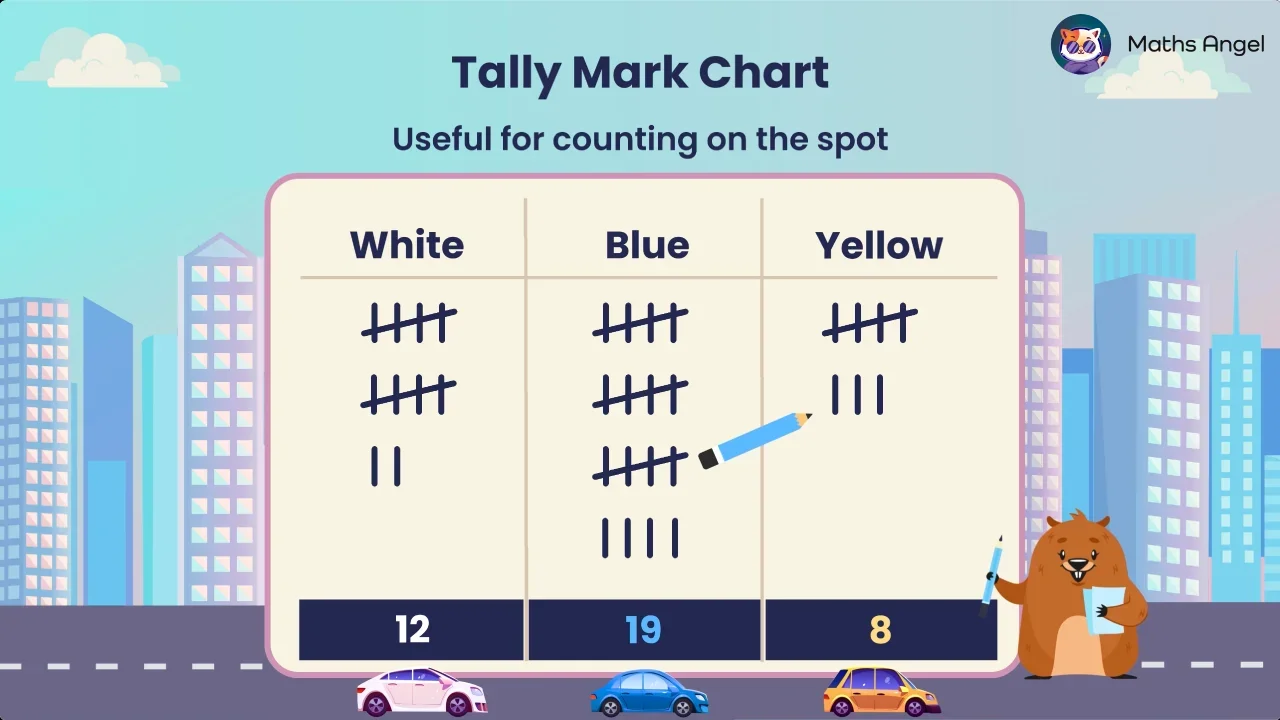
- Tally marks are used to count data as it is collected (e.g. number of cars passing).
- Marks are grouped in fives to make totals quicker and avoid miscounting.
How to Read a Bar Chart?
- Bar charts are used to compare amounts between groups (e.g. red cars vs blue cars).
- Read the number on the axis to find the value of each group.
What Is a Table Used For?
- Tables organise data so numbers can be read clearly and exactly.
- They save space and are useful when listing many values.
When to Use Each Type of Chart
- The same data can be shown in different formats.
- Use tally charts to collect data, tables to organise it, and bar charts to compare it.
Practice Questions
Test your understanding
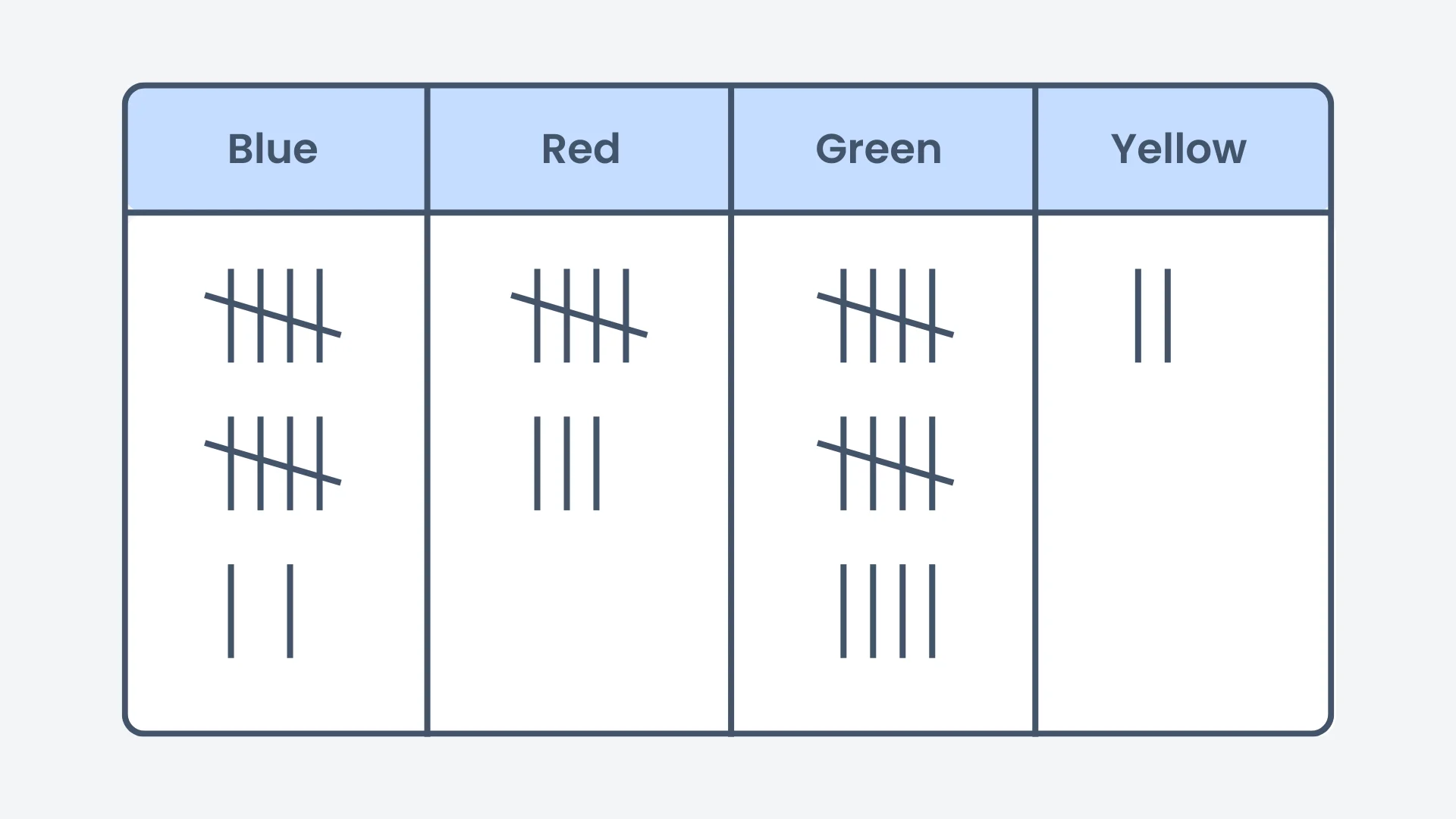
The tally chart shows the colours of a bag of marbles. How many marbles are red?
Correct! 🎉 +10 pointsCorrect! 🎉 Worth 10 XPNot quite right
In the Red column there is one crossed group of five marks and then three single marks.
, so 8 marbles are red.
In a bar chart, what does the height of each bar represent?
Correct! 🎉 +10 pointsCorrect! 🎉 Worth 10 XPNot quite right
The height of a bar is read against the frequency axis, so it tells you how many items were counted in that category.
The category itself is shown by the label under the bar, not by how tall the bar is.
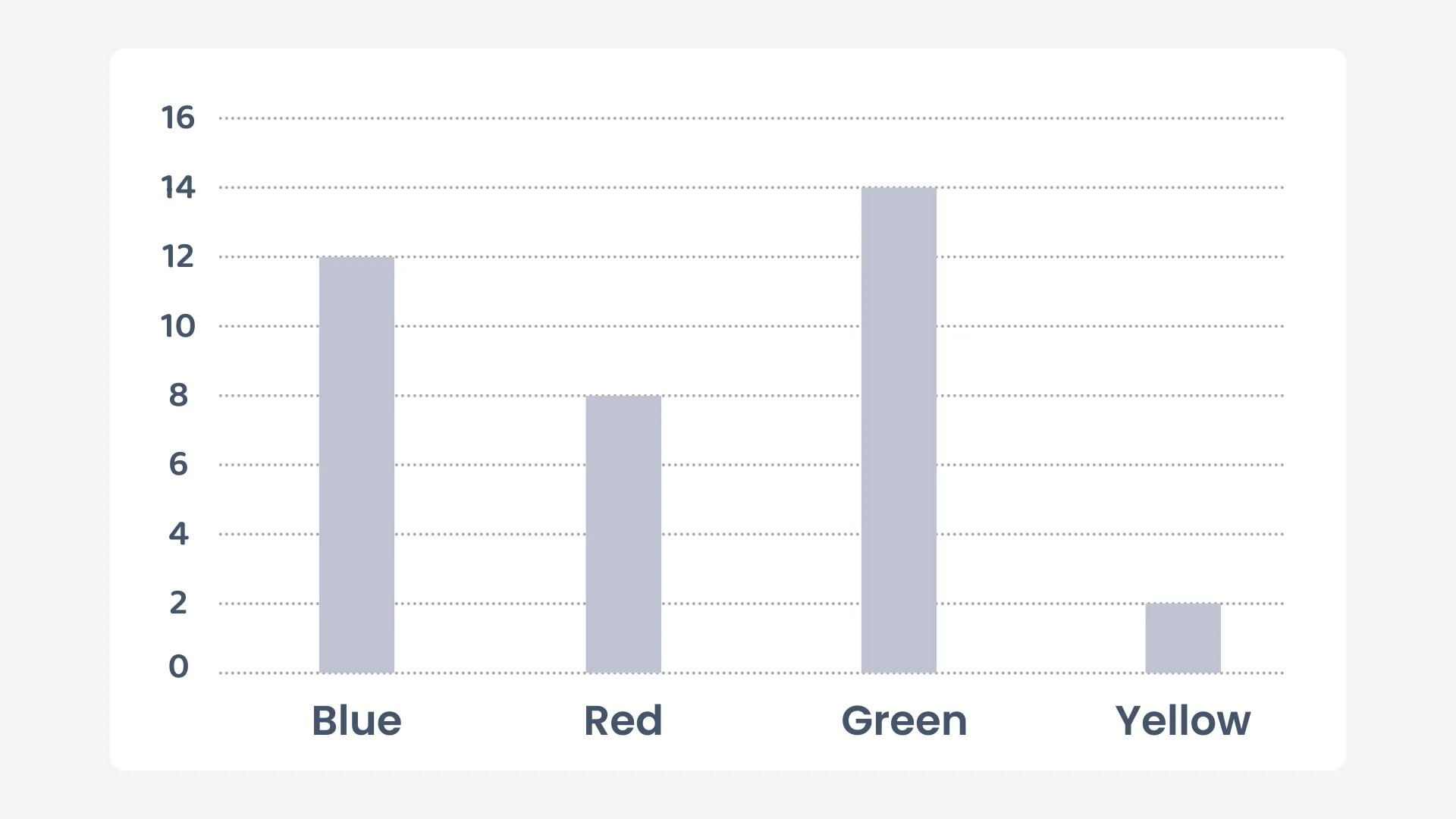
How many more blue marbles did we count than yellow marbles?
Correct! 🎉 +20 pointsCorrect! 🎉 Worth 20 XPNot quite right
Read each bar against the vertical scale, which goes up in twos.
The blue bar reaches 12 and the yellow bar reaches 2.
How many more means find the difference: .
So there are 10 more blue marbles than yellow marbles.
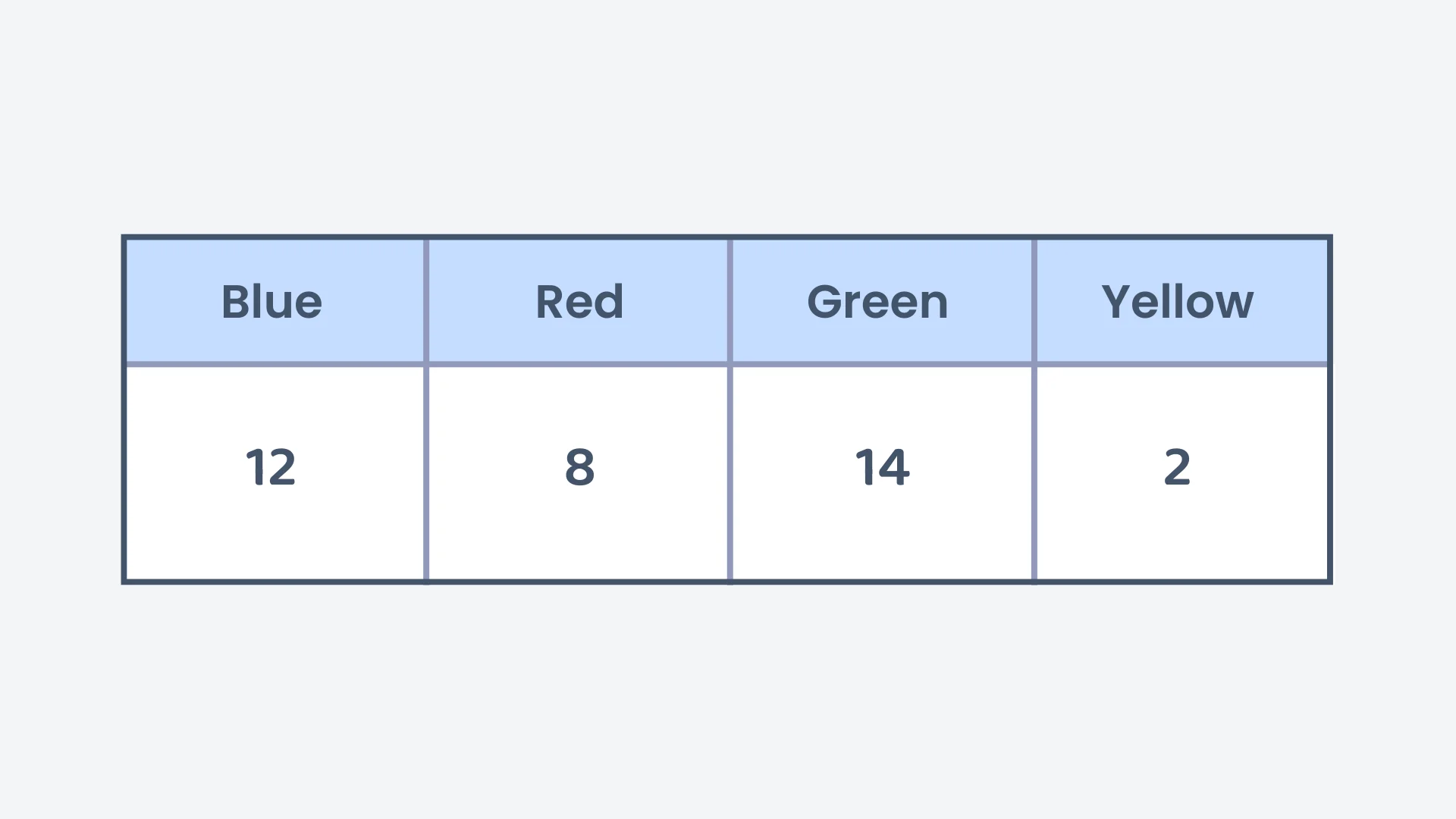
How many marbles are there in total?
Correct! 🎉 +20 pointsCorrect! 🎉 Worth 20 XPNot quite right
The table gives a count for every colour: blue 12, red 8, green 14 and yellow 2.
In total means add all four counts, not just some of them:
So there are 36 marbles in total.
If you want to show this data in a bar chart, which bar should be the tallest?
Correct! 🎉 +20 pointsCorrect! 🎉 Worth 20 XPNot quite right
The tallest bar belongs to the colour with the most marbles, so compare all four counts: 12, 8, 14 and 2.
The largest count is 14, which is the green column, so the Green bar should be the tallest.
Compare the whole numbers, not single digits: 8 has the biggest single digit but 8 is smaller than both 12 and 14.
Suppose there are 17 white marbles. How should you write this in tally marks?
Correct! 🎉 +30 pointsCorrect! 🎉 Worth 30 XPNot quite right
Tally marks are grouped in fives: four lines with a fifth line struck across them, so one bundle stands for 5.
Work out how many fives are in 17: remainder .
So 17 is 3 bundles (that is 15) plus 2 single lines.
Never leave five or more loose lines: as soon as you have five they should be grouped into another bundle.
Want to see the full working?
Interactive Activity
Visualise data with Tally Mark Charts, Bar Charts, and Tables
Loading interactive widget...
Frequently asked questions
The questions students bump into most on this topic
Tally marks are short lines used to count things as they happen, one line for each item. Every fifth line is drawn across the previous four to make a bundle of five, so the marks are quick to count later. For example, 2 bundles and 2 extra lines mean 12 cars.
Draw one short line for each item. When you reach the fifth item, draw a line across the previous four to close a bundle of five, then start a new bundle. To read a tally, count the bundles in fives and add the leftover lines: 3 bundles and 4 lines make 19, and 40 is 8 complete bundles.
A bar chart shows data as bars of different heights so you can compare groups at a glance. The categories go along the horizontal axis and the counts up the vertical axis, and the height of each bar is the value for that group. The tallest bar is the biggest group. In the US it is called a bar graph.
Label the horizontal axis with the categories, such as car colours, and the vertical axis with the count. Draw one bar for each category, making its height equal to the number counted. For clarity, write the exact number inside or above each bar. Then the tallest bar shows the most popular group and the shortest the least.
Use a bar chart when you want to compare groups visually: the difference between the tallest bar, blue at 19, and the shortest, yellow at 8, is 19 − 8 = 11 cars at a glance. Use tally marks to count on the spot as things happen, and a table when you want a short, exact summary that takes little space.
What's next?
Found this one hard? Go one step back first. Feeling confident? Carry on to the next lesson.