How to Find X-Intercept, Y-Intercept and Intersections
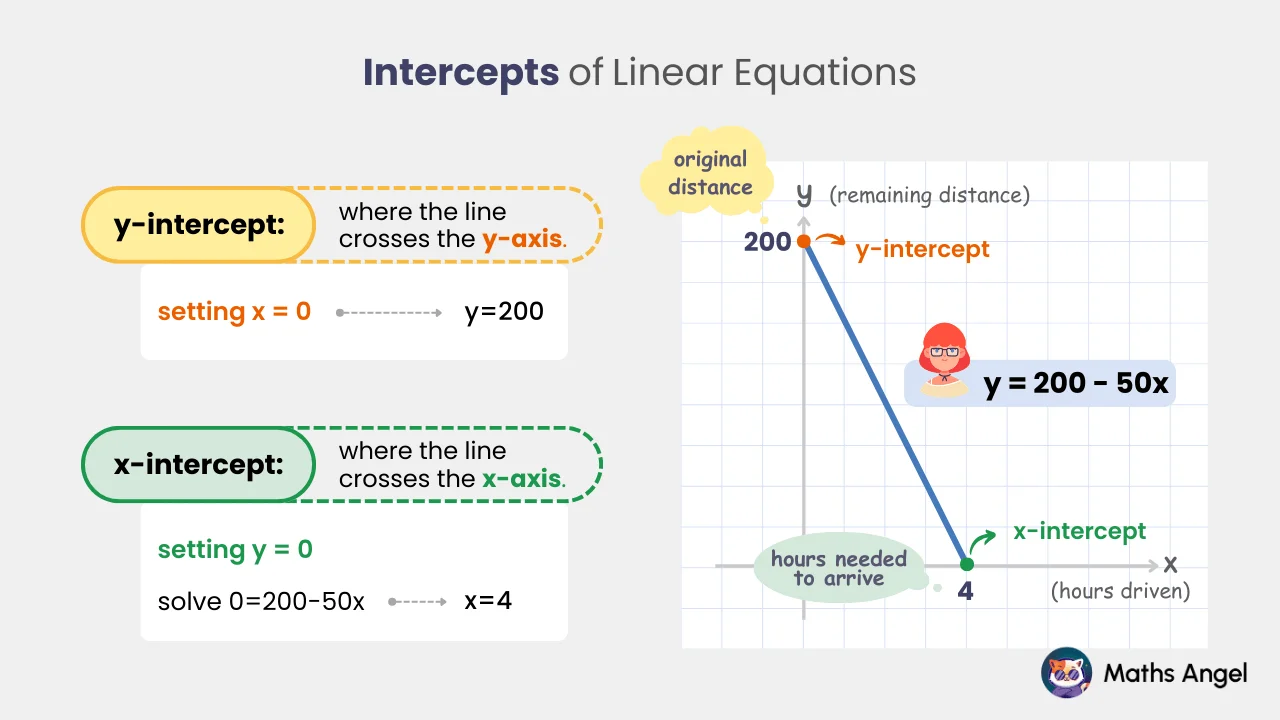
The x-intercept is found by setting y = 0, and the y-intercept by setting x = 0. For y = 200 − 50x, this gives an x-intercept of 4 and a y-intercept of 200. Two lines intersect where they share the same x and y values.
Video Lesson
Watch and learn the basics
🎬 Did this video explain it clearly?
Flashcards
Review key concepts visually
%20Intercepts%20of%20Linear%20Equations.webp)
%20Intersection%20of%20Linear%20Equations.webp)
%20Determining%20the%20Intersection.webp)
Finding Intercepts from an Equation
- For , setting gives a y-intercept of 200.
- Setting and solving gives the x-intercept of 4.
Intersections of Linear Equations
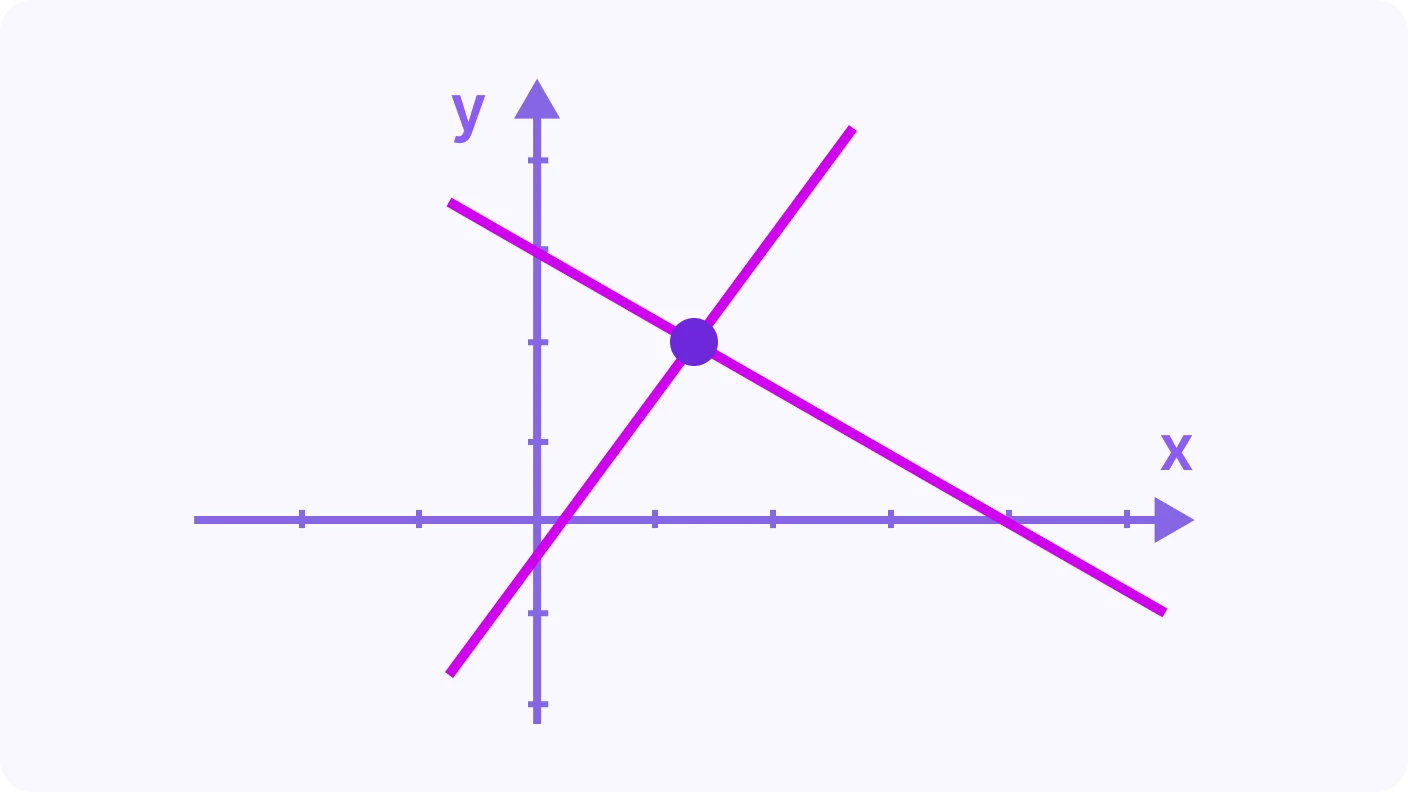
- An intersection is the point where two lines meet.
- At the intersection, both equations have the same x and y values.
Finding the Intersection Point
- Set the two equations equal to each other to find x.
- Put the value of x back into any equation to find y.
Practice Questions
Test your understanding
In the equation , what is the y-intercept?
Correct! 🎉 +10 pointsCorrect! 🎉 Worth 10 XPNot quite right
The y-intercept is the constant term c in , so here it is 2.
It is the value of y when : . The line crosses the y-axis at the point , and the y-intercept is 2.
In the equation , what is the x-intercept?
Correct! 🎉 +10 pointsCorrect! 🎉 Worth 10 XPNot quite right
The x-intercept is where the line crosses the x-axis, so set : .
Adding to both sides gives , so . The crossing point is and the x-intercept is 2.
Given the equations and , what is the intersection point?
Correct! 🎉 +20 pointsCorrect! 🎉 Worth 20 XPNot quite right
At the intersection both equations give the same y, so set the right-hand sides equal: .
Add x to both sides and subtract 2: , so .
Substitute back to find y: (check with the other line: ). The intersection point is (1, 5).
Find the point of intersection of the lines and .
Correct! 🎉 +20 pointsCorrect! 🎉 Worth 20 XPNot quite right
Set the right-hand sides equal: .
Add to both sides and add 1 to both sides: , so .
Substitute back to find y: (check with the other line: ). The intersection point is (1, 3).
Find the intersection of the lines and .
Correct! 🎉 +20 pointsCorrect! 🎉 Worth 20 XPNot quite right
Set the right-hand sides equal: .
Add x to both sides and subtract 1: , so .
Substitute back to find y: (check with the other line: ). The intersection point is (3, 7).
A car starts with 120 litres of fuel. The car burns 6 litres of fuel every hour. After a few hours, 60 litres of fuel are left. How many hours has the car been driven?
Correct! 🎉 +30 pointsCorrect! 🎉 Worth 30 XPNot quite right
The fuel used is litres.
Writing this as an equation with hours driven: . Setting gives , so and .
The car has been driven for 10 hours.
Want to see the full working?
Interactive Activity
Graph linear equations and find their intersection point
Loading interactive widget...
Frequently asked questions
The questions students bump into most on this topic
They are the points where a line crosses, or intercepts, the two axes. The y-intercept is on the y-axis, where x = 0; the x-intercept is on the x-axis, where y = 0. For Amy’s journey, y = 200 − 50x, the y-intercept of 200 is her starting distance and the x-intercept of 4 is the hour she arrives.
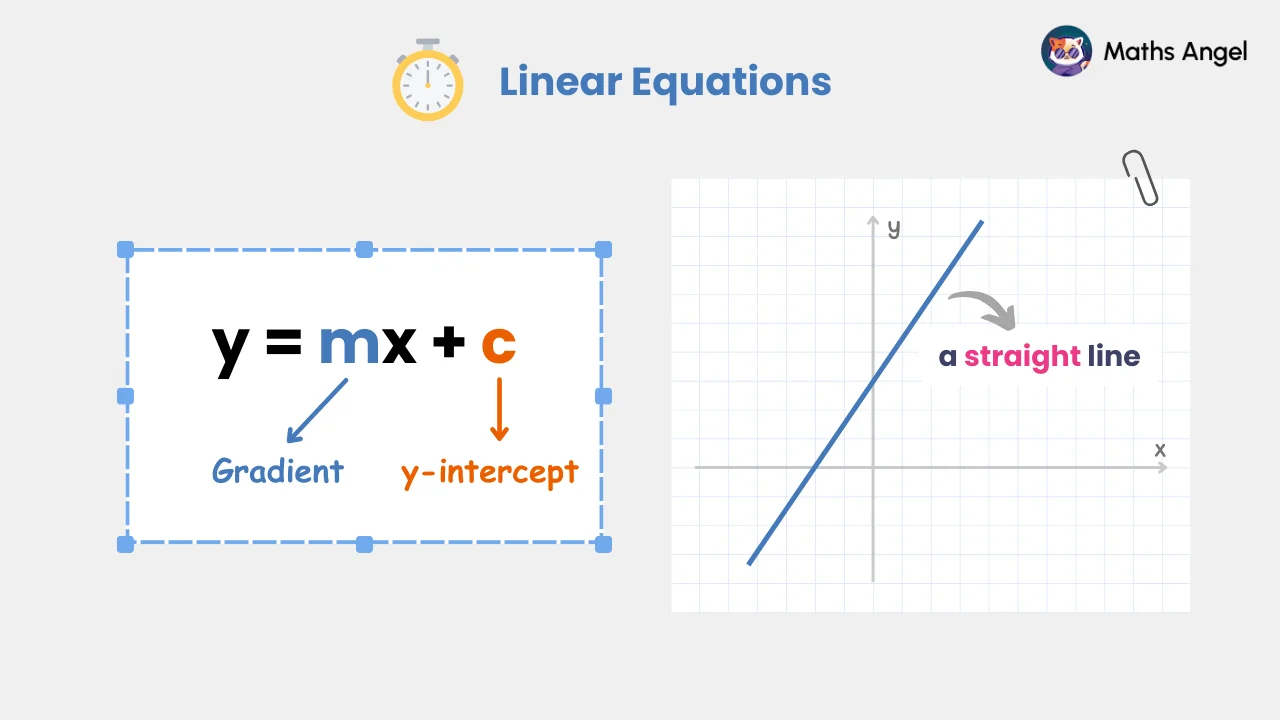
Set x to 0 and work out y. For y = 200 − 50x, x = 0 gives y = 200, so the y-intercept is 200. When the equation is in the form y = mx + c, the y-intercept is simply c: for y = 3x + 2 it is 2. On a graph it is where the line crosses the y-axis.
Set y to 0 and solve for x. For y = 200 − 50x: 0 = 200 − 50x, so 50x = 200 and x = 4. For y = −4x + 8: 0 = −4x + 8 gives x = 2. The same works for Google’s 3x + 5y + 15 = 0: with y = 0, 3x = −15, so x = −5. On a graph it is where the line crosses the x-axis.
The point where two lines cross. At that point both equations have the same x and the same y, so it is the one pair of values that fits both lines. Amy’s journey, y = 200 − 50x, and Bobby’s, y = 150 − 30x, cross at (2.5, 75): after 2.5 hours both are 75 miles from the theme park.
Two steps, no graph needed. Set the two equations equal and solve for x: 200 − 50x = 150 − 30x, so 50 = 20x and x = 2.5. Then put x into either equation to find y: 150 − 30 × 2.5 = 75. The intersection is (2.5, 75). Reading it off a graph gives the same point, but the algebra is exact.
Either one, because the point lies on both lines, so choose whichever has the easier numbers. For Amy and Bobby, Bobby’s y = 150 − 30x is simpler: 150 − 30 × 2.5 = 75. Amy’s gives the same: 200 − 50 × 2.5 = 75. Using the second equation as a check costs one line and catches mistakes.
What's next?
Found this one hard? Go one step back first. Feeling confident? Carry on to the next lesson.