
Density, Mass and Volume
Density, mass and volume are linked by density = mass ÷ volume. It shows how much mass is packed into a space, so 100 g in 50 cm³ gives 2 g/cm³. Rearrange it to get mass = density × volume.
Video Lesson
Watch and learn the basics
🎬 Did this video explain it clearly?
Flashcards
Review key concepts visually
%20What%20Is%20Density%2C%20Mass%20and%20Volume%3F.webp)
%20The%20Density%20Triangle.webp)
%20Finding%20Density.webp)
%20Finding%20Mass.webp)
%20Finding%20Volume.webp)
%20Finding%20Mass%20-%20Practice.webp)
What Is Density, Mass and Volume?
- Mass means how heavy something is (measured in g or kg).
- Volume means how much space something takes up (measured in cm³ or m³).
- Density means how packed something is (measured in g/cm³ or kg/m³).
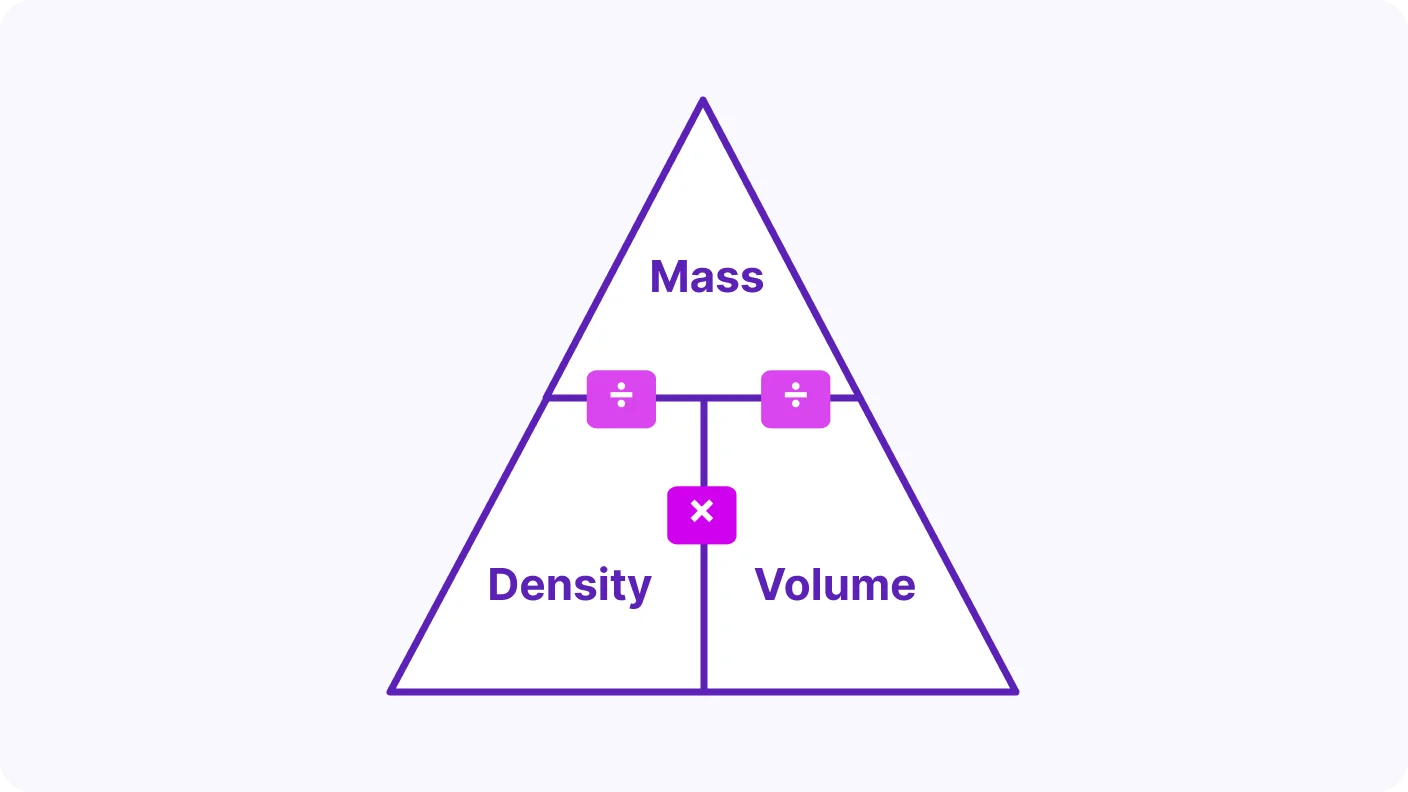
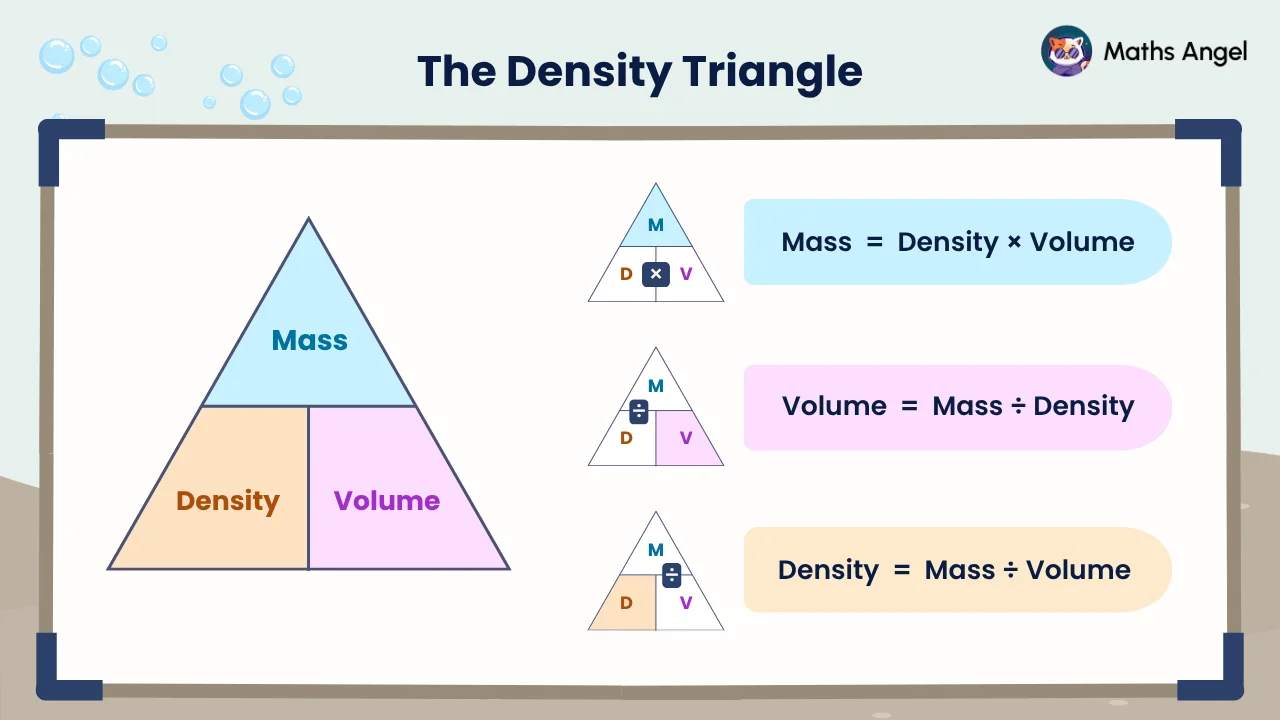
The Density Triangle Trick
- The density triangle helps you choose the correct formula.
- Mass = Density × Volume, Volume = Mass ÷ Density, and Density = Mass ÷ Volume.
Finding Density
- To find density, divide mass by volume.
- , so the chocolate has a density of /cm³.
Finding Mass
- To find mass, multiply density by volume.
- , so the wooden block has a mass of .
Finding Volume
- To find volume, divide mass by density.
- , so the medal has a volume of .
Gold Bar Practice
- First find the volume by multiplying length × width × height.
- , so the gold bar has a volume of .
- , so the gold bar has a mass of .
Practice Questions
Test your understanding
A block of metal has a mass of and a volume of . Find its density.
Correct! 🎉 +10 pointsCorrect! 🎉 Worth 10 XPNot quite right
Use density = mass ÷ volume.
So .
The density is /cm³.
(Mass always goes on top. Dividing the other way round, , gives volume per gram, not density.)
A glass marble has a density of /cm³ and a volume of . Find its mass.
Correct! 🎉 +10 pointsCorrect! 🎉 Worth 10 XPNot quite right
Use mass = density × volume.
So .
The mass is .
(Keep track of the decimal point: , so .)
An aluminium bar has a mass of and a density of /cm³. Find its volume.
Correct! 🎉 +20 pointsCorrect! 🎉 Worth 20 XPNot quite right
Use volume = mass ÷ density.
So .
The volume is .
(Check the size of the answer: of aluminium at /cm³ does weigh g.)
A pine block has a mass of and a volume of . Find its density.
Correct! 🎉 +20 pointsCorrect! 🎉 Worth 20 XPNot quite right
Use density = mass ÷ volume.
So .
The density is /cm³.
(A common slip is to divide the wrong way round, . Mass always goes on top, and because the mass is smaller than the volume the density must be less than 1.)
A solid metal cube has a mass of and a density of /cm³. Find the length of one side of the cube.
Correct! 🎉 +20 pointsCorrect! 🎉 Worth 20 XPNot quite right
First find the volume using volume = mass ÷ density:
For a cube, volume = side × side × side, so the side is the cube root of the volume:
because .
The side length is .
(Two traps: stopping at the volume of , and thinking the cube root means dividing by 3.)
A steel ingot in the shape of a cuboid measures by by . Steel has a density of /cm³. Find the mass of the ingot.
Correct! 🎉 +30 pointsCorrect! 🎉 Worth 30 XPNot quite right
We aren't given the volume, so find it first.
For a cuboid, volume = length × width × height .
Then use mass = density × volume:
The mass is .
(All three measurements must be multiplied together: alone is only the area of one face.)
Want to see the full working?
Interactive Activity
Tap the triangle to choose what to find, then adjust the values
Loading interactive widget...
Density, Mass and Volume frequently asked questions
The questions students bump into most on this topic
Mass is how heavy an object is, measured in grams or kilograms. Volume is how much space it takes up, measured in cubic centimetres or cubic metres. Density is how much mass is packed into that space, measured in grams per cubic centimetre. The three are linked by the density triangle.
The density triangle gives three formulas. Density equals mass divided by volume. Mass equals density times volume. Volume equals mass divided by density. You choose the right one by covering the letter you want to find. Then read the other two letters on the triangle.
Work out the volume first, then use it. For a cuboid, volume equals length times width times height. For example, a bar measuring 5 cm by 2 cm by 1 cm has a volume of 10 cm³. You can then multiply by the density to find the mass.
Density is measured in grams per cubic centimetre (g/cm³) or kilograms per cubic metre (kg/m³). Each unit combines a mass unit with a volume unit. This matches the density formula. You divide a mass by a volume to see how much mass fits in each unit of space.
Cover the letter you want to find. If the other two letters sit side by side, multiply them. If one letter sits above the other, divide the top letter by the bottom one. So mass equals density times volume, and density equals mass divided by volume.