
Speed, Distance and Time
Speed, distance and time are linked by one formula: speed = distance ÷ time. So a car going 100 miles in 2 hours travels at 50 mph. Rearrange it to get the other two: distance = speed × time and time = distance ÷ speed.
Video Lesson
Watch and learn the basics
🎬 Did this video explain it clearly?
Flashcards
Review key concepts visually
%20The%20Speed%20Triangle.webp)
%20Finding%20Distance.webp)
%20Finding%20Speed.webp)
%20Finding%20Time.webp)
%20Practice%20-%20Finding%20Speed%20with%20Mixed%20Time.webp)
%20Practice%20-%20Finding%20Speed%20with%20Time%20in%20Minutes.webp)
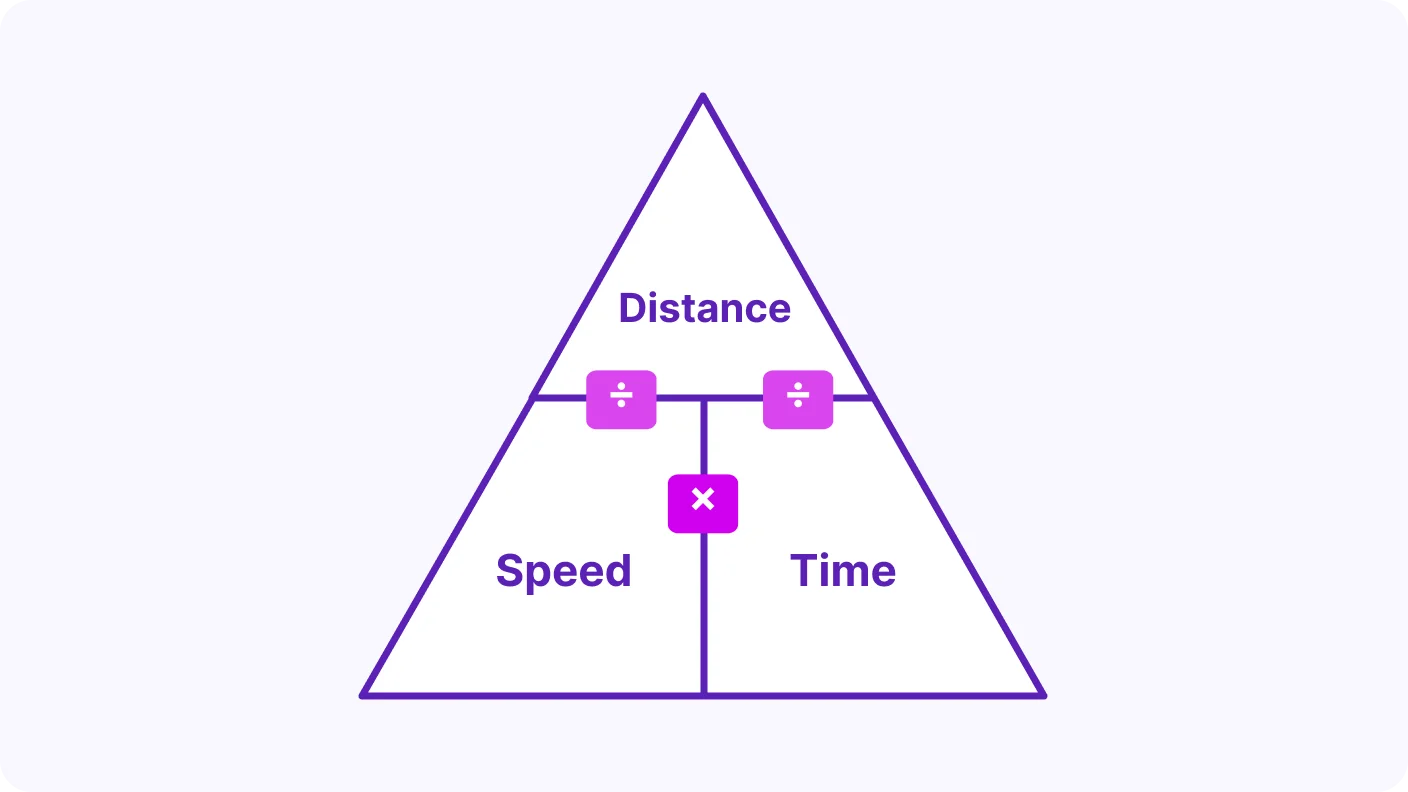
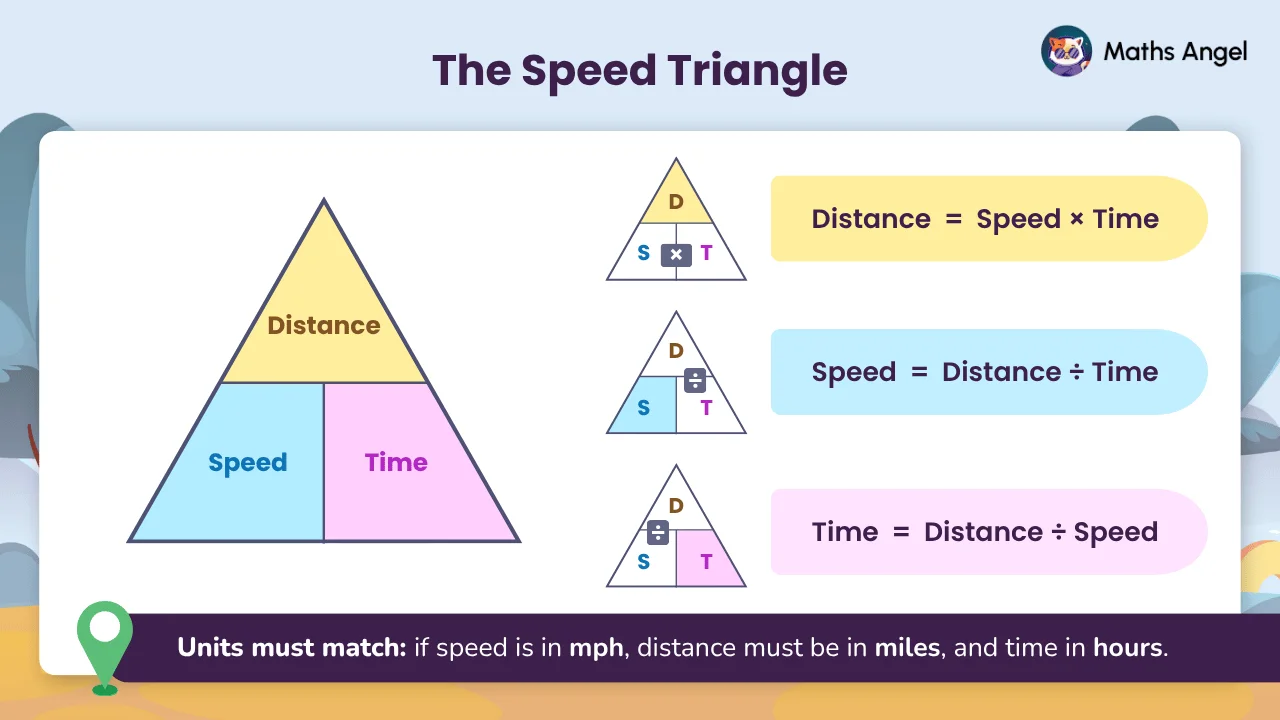
The Speed Triangle
- Distance sits on top, with Speed and Time underneath.
- Distance = Speed × Time, Speed = Distance ÷ Time, Time = Distance ÷ Speed
- Keep your units matched, such as mph with miles and hours.
Finding Distance
- When you know the speed and the time, multiply them to get the distance.
- Distance = Speed × Time
- A cyclist at 8 mph for 2.5 h covers miles.
Finding Speed
- When you know the distance and the time, divide the distance by the time.
- Speed = Distance ÷ Time
- A car going in 4 h has speed .
Finding Time
- When you know the distance and the speed, divide the distance by the speed.
- Time = Distance ÷ Speed
- A jogger doing 15 miles at 6 mph takes min.
Speed with Mixed Time
- A time like 3 h 30 min must become decimal hours before you divide.
- 30 , so 3 h 30 .
- Then .
Speed with Minutes
- A time given only in minutes must be changed to hours first.
- Divide by 60: .
- Then 30 miles mph.
Practice Questions
Test your understanding
A cyclist travels at 10 miles per hour for 3 hours. How far does the cyclist travel?
Correct! 🎉 +10 pointsCorrect! 🎉 Worth 10 XPNot quite right
Use distance = speed × time.
So .
The cyclist travels 30 miles.
The speed and the time must be multiplied, not added, subtracted or divided. A quick sense check: 10 miles by the end of the first hour, 20 by the second, 30 by the third.
A car travels in 2 hours. What is its average speed?
Correct! 🎉 +10 pointsCorrect! 🎉 Worth 10 XPNot quite right
Use speed = distance ÷ time.
So .
The average speed is per hour.
The distance goes on top and the time underneath. Because , finding the speed means undoing that multiplication by dividing. Multiplying gives , which is not the speed. And dividing the other way round, , gives an answer far too small for a car. Always sense-check the size of your answer.
A train travels at an average speed of per hour. How long does the journey take?
Correct! 🎉 +20 pointsCorrect! 🎉 Worth 20 XPNot quite right
Use time = distance ÷ speed.
So .
Half an hour is 30 minutes, so 1.5 hours is 1 hour 30 minutes.
Three things to watch. Time is not base-10, so the 0.5 is 30 minutes, not 50. The leftover half hour must not be chopped off, so the answer is not 1 hour. And dividing the other way round gives , which as a fraction of an hour is 40 minutes, the numbers used back to front.
A cyclist travels at 12 miles per hour for 1 hour and 30 minutes. How far does the cyclist travel?
Correct! 🎉 +20 pointsCorrect! 🎉 Worth 20 XPNot quite right
First convert the time. 30 minutes is half an hour, so 1 hour 30 minutes is 1.5 hours (not 1.3 hours: time is not base-10).
Use distance = speed × time. So .
The cyclist travels 18 miles.
Check the common slips: using 1.3 hours gives miles; dividing instead of multiplying gives miles; and ignoring the extra half hour gives only miles.
A runner completes in 40 minutes. What is the runner's average speed in km per hour?
Correct! 🎉 +20 pointsCorrect! 🎉 Worth 20 XPNot quite right
First convert the time. 40 minutes is of an hour (not 0.4 of an hour).
Use speed = distance ÷ time. So .
Check it: the runner covers every 20 minutes, so in 60 minutes.
A car travels 100 miles in 2 hours, then a further 120 miles in the next 3 hours. What is the average speed for the whole journey?
Correct! 🎉 +30 pointsCorrect! 🎉 Worth 30 XPNot quite right
Average speed uses the totals, not each stage separately.
Total distance is and total time is .
Use speed = distance ÷ time. So .
The average speed is 44 miles per hour.
The stage speeds are mph and mph. Stopping at the first of those gives 50 mph, which ignores the rest of the journey; averaging the two gives 45 mph, which is wrong because more time was spent at the slower speed; and adding them gives 90 mph, which is not an average at all.
Want to see the full working?
Interactive Activity
Tap a corner of the triangle and adjust the values to find speed, distance or time.
Loading interactive widget...
Speed, Distance and Time frequently asked questions
The questions students bump into most on this topic
The speed distance time triangle gives three formulas. Distance equals speed times time. Speed equals distance divided by time. Time equals distance divided by speed. Cover the quantity you want to find, and the other two letters show whether to multiply or divide them.
Picture distance at the top, with speed and time side by side at the bottom. To use it, cover the letter you want to find. If the other two sit side by side, you multiply. If one sits above the other, you divide the top by the bottom.
The units must match each other. If the speed is in miles per hour, the distance must be in miles and the time must be in hours. If a value uses different units, convert it first. For example, change minutes into hours before you divide.
Divide the number of minutes by 60, because one hour has 60 minutes. For example, 45 minutes divided by 60 is 0.75 hours. If a time is given as 3 hours and 30 minutes, 30 minutes is half an hour, so the total is 3.5 hours.
Keep the whole number of hours first. Then multiply the decimal part by 60 to change it into minutes. For example, 2.5 hours becomes 2 hours plus 0.5 times 60, which is 30 minutes. So 2.5 hours is 2 hours and 30 minutes.