Distributive Law
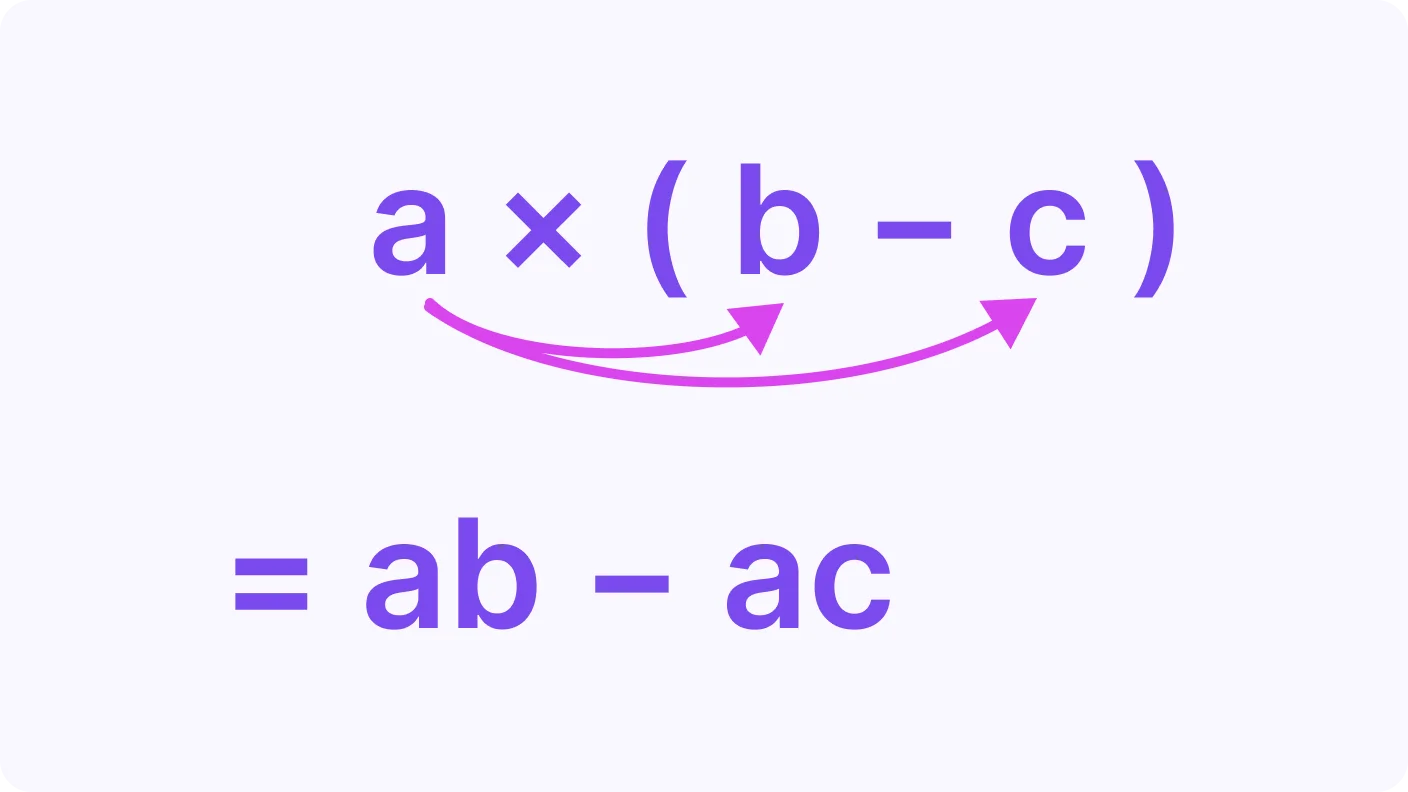
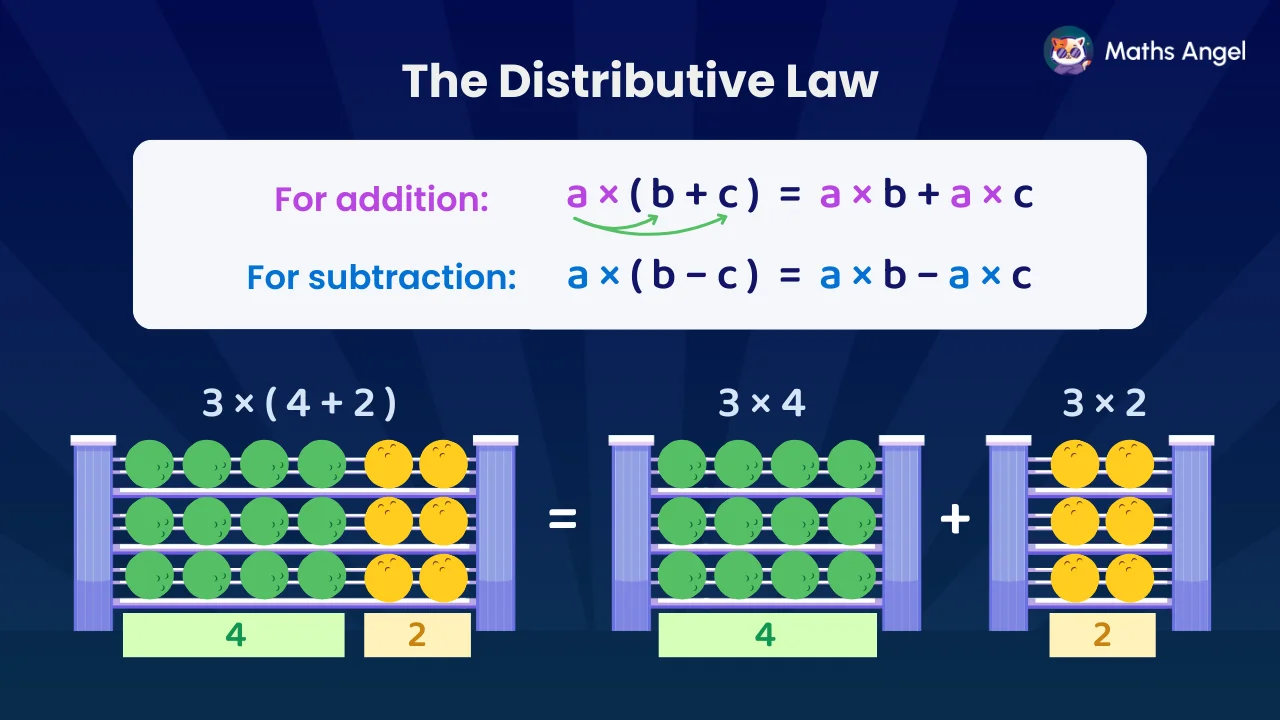
The distributive law (or distributive property) means multiplying the number outside the brackets by each term inside, so a × (b + c) = a × b + a × c and a × (b − c) = a × b − a × c. It works both ways to expand brackets or factorise.
Video Lesson
Watch and learn the basics
🎬 Did this video explain it clearly?
Flashcards
Review key concepts visually
%20The%20Distributive%20Law.webp)
%20Applying%20the%20Distributive%20Law.webp)
%20Distributive%20Law%20for%20Multiple%20Numbers.webp)
%20Remarks%20on%20the%20Distributive%20Law.webp)
What is the Distributive Property?
- The distributive property means multiplying a number across brackets.
- It is written as .
Applying the Distributive Property
- Multiply the number outside the brackets by each term inside.
- This can be used to expand brackets or simplify calculations.
Distributive Property with More Than Two Terms
- The distributive property also works with more than two terms.
- For example, .
Should I Use the Distributive Property with Division?
- Do not use the distributive property when dividing.
- When there is division, it is usually better to calculate inside the brackets first.
Practice Questions
Test your understanding
Work out: 4 × (25 + 6)
Correct! 🎉 +10 pointsCorrect! 🎉 Worth 10 XPNot quite right
Work out the bracket first: . Then multiply: .
You can also use the distributive property: . Notice that the 4 must multiply both parts inside the bracket.
Work out: 8 × (50 + 2)
Correct! 🎉 +10 pointsCorrect! 🎉 Worth 10 XPNot quite right
Work out the bracket first: . Then multiply: .
Using the distributive property: . The 8 has to multiply the 2 as well as the 50.
Work out: 7 × (80 − 3)
Correct! 🎉 +20 pointsCorrect! 🎉 Worth 20 XPNot quite right
Work out the bracket first: . Then multiply: .
Using the distributive property: . Because the bracket contains a subtraction, the second product is subtracted, not added.
Work out: 8 × (70 − 5)
Correct! 🎉 +20 pointsCorrect! 🎉 Worth 20 XPNot quite right
Work out the bracket first: . Then multiply: .
Using the distributive property: . The 8 multiplies the 5 as well, and that product is subtracted.
Work out: 8 × 51
Correct! 🎉 +20 pointsCorrect! 🎉 Worth 20 XPNot quite right
Partition 51 into 50 + 1 and use the distributive property: .
Both parts must be multiplied by 8, and the 8 from 8 × 1 belongs in the ones column.
Work out: 12 × 102
Correct! 🎉 +30 pointsCorrect! 🎉 Worth 30 XPNot quite right
Partition 102 into 100 + 2 and use the distributive property: .
The extra 2 is worth two whole groups of 12, which is 24, not just 2.
Want to see the full working?
Interactive Activity
Click the number to distribute it to the terms inside
Loading interactive widget...
Frequently asked questions
The questions students bump into most on this topic
The distributive law says that multiplying a number by a sum is the same as multiplying it by each part and adding the results: a × (b + c) = a × b + a × c. It works with subtraction too. Unlike the associative law, which only regroups, it mixes multiplication with addition, which is why it is so useful for mental maths.
Multiply the number outside the brackets by each term inside, then add or subtract the results. To work out 15 × (100 + 2): 15 × 100 = 1,500 and 15 × 2 = 30, so the answer is 1,530. It also runs backwards: 50 × 24 − 50 × 14 has 50 in both parts, so it is 50 × (24 − 14) = 50 × 10 = 500.
Break the awkward number into parts that are easy to multiply, then share the multiplication across all of them. To work out 5 × 221, split 221 into 200 + 20 + 1: (5 × 200) + (5 × 20) + (5 × 1) = 1,000 + 100 + 5 = 1,105. The law works with as many parts as you need.
Generally no: it is a property of multiplication, so avoid using it with division. It only works when the brackets sit on the left, as in (19 + 2) ÷ 3, and even then it does not help, because 21 ÷ 3 = 7 is quicker. With division, work out the brackets first.
Set out 3 rows of balls, each with 4 green and 2 yellow. Ask how many there are: your child can count 3 rows of 6, which is 3 × (4 + 2) = 18, or count the greens and yellows separately, 3 × 4 + 3 × 2 = 12 + 6 = 18. Both routes give 18, and that is the distributive law.
What's next?
Found this one hard? Go one step back first. Feeling confident? Carry on to the next lesson.